Showing posts with label SexualReproductive Health/Rights. Show all posts

Sunday, 18 August 2013

Those who bash women for 'delaying motherhood' are hypocrites, don't understand human reproduction

Having reached the advanced age of mid-thirties, my attention is called quite often to articles and opinion pieces in the news regarding us stubborn, career-driven harpies who refuse to reproduce until we are good and ready, only to find that after the witching year of 35, things aren't so easy. Your eggs are old, lady! Give up and get a cat. Serves you right, anyway. The Daily Fail is full of these types of pieces - 'personal interest' stories about some poor 40-year old woman who would give up all her success, designer shoes and non-essential organs if only she could go back and have a kid at 20. Or worse: a woman who did manage to have children after 35 or 40, but is now too old and decrepit to chase them up into trees or stay awake during Mommy and Me.

Now I can't be strictly sure that there are more such stories than before, (since when I was a wee sprinbok in my twenties concerned only with non-procreative sex, drugs and rock-and-roll, and that f**king career, I likely would not have noticed them anyway), but from all the apocalyptic yelling going on about it of late, it would certainly seem as if humanity is in decline: no one is having any babies, and the end is nigh, and it's all your infertile fault, thirty-something lady. Except, not so much. In the US, where much of the yelling is happening, infertility rates are on the decline, and not because more people are having fertility treatments; this latter statistic has remained flat since 2002. In the UK, adult infertility numbers are being linked more and more to male infertility, with "male factors now accounting for 30 percent of fertility problems - the same as female factors". Even in Europe, where falling fertility rates (ratio of live births in an area to the population of that area) since 2008 are being flagged as alarming, they are closely linked in the research to the economic recession. That is, countries like Spain and Greece which fared among the worst saw the sharpest decreases in fertility rates, while those with better performance recorded no change or even increases. In other words, it's less about women's 'selfish choices' (whatever those are) and more about real or perceived and/or future financial constraint. Even the Daily Fail is forced to admit the relationship between financial situation and reproductive decisions. A similar argument can be made in Latin America and the Caribbean, where fertility rates are in fact falling, though in general not yet having reached the below replacement levels of 'developed' countries. The region as a whole still reflects Bloom's 'demographic dividend' - with an economically active population that is greater than the dependent population - but this may not last much longer, particularly in the Eastern Caribbean. Still, high levels of migration in the working age population are more likely behind this than Caribbean women's refusal to have children.

And this new debate, if not presented as willful non-compliance in the business of populating the earth, is presented as emerging wisdom to fill some gap in knowledge: women have simply had the wrong information. Hey ladies, I know you thought you could wait forever and carry out your own, selfish lady-business before reproducing, but nuh uh, missy, NEW RESEARCH shows you're about to expire. As someone who has owned a uterus for over thirty years, let me say this: we know. I'm not saying that every woman everywhere is in possession of an identical body of knowledge. In fact, we know this not to be true, which is part of the reason sharing information on sexual and reproductive health and access remains important. But a high percentage of the target audience for this blame-a-thon - professional women with tertiary or advanced technical education - already. Know. They are all too aware of their declining fertility. This is one of those cases in which knowledge on its own cannot translate into action. In simpler terms: even armed with this information, what would you have them do? Certainly not run out and fall pregnant by some random, which itself attracts its own brand of she's-a-witch vilification, and is the basis of much urban legend. Everyone knows someone who knows someone whose dressmaker's neighbour's domino partner was tricked into fatherhood by some desperate thirty-something. Always something with these women - either they're 20 and poking holes in condoms to trap a cricketer (cause we all know how deep cricketers are rolling), or 30 and going off the pill so their boyfriend will marry them goddamit, or 40 and having one night stands with friends/strangers, then spiriting away their sperm. Tricky tricksters.

The thing is, every reproductive choice a woman makes at this age is criticized.
Happily child-free? You're selfish and just want to keep your flat belly and boozing ways.
Unhappily child-free? Your fault. You used to be selfish and just wanted to have your career, flat belly and boozing ways.
Child-free, single and trying to conceive? Hoor! Children are for couples. And what about your poor, fatherless child? Single mothers are everything that's wrong with the world. You're selfish and just want to have a child to love you.

Herein lies the hypocrisy. And even had they had this knowledge earlier, before it was Too Late, the same applies.

Me explico. Growing up in Barbados, getting pregnant was the worst thing you could do. Not just as a teenager, but anytime before you had secured your place as a DoctorLawyerBankmanager. I'm serious. The Worst Thing. Teenage or 'early' pregnancy was blamed for all the ills of society, directly or indirectly. Boys are under-performing in school? Teenage pregnancy (and girls' sexuality). Never mind that the boys' (teenage fathers') asses are sat in classrooms while the girls are the ones run out of school with pitchforks. The dubious problem of society losing its morals? The dubious explanation of teenage pregnancy. Drowning at Miami Beach? Teenage pregnancy. Winston Hall escaped from jail again? Teenage pregnancy. And so on. It doesn't matter what issue is at hand. Invariably, in any meeting anywhere on the island, someone is going to raise his hand confounded that we are four minutes into the session and no one has brought up the scourge of teenage pregnancy.

None of this was lost on the generation of women now in our mid-thirties. In the Caribbean, for children of the working class, education - and I'm not talking just high school I'm talking first or advanced degree - is the handful of magic beans. You had better get it and stick with it until you can prove to people that your family is officially out of the working class. So for women, pregnancy is to be avoided at all costs even into your twenties. Of course, people get pregnant in their early twenties and are not made to wear a scarlet A, but it is hoped in general that you get your papers before you get your pickney. And then there's the whole wedlock business. I noticed growing up that the least Christian of Caribbean people could utter the phrase 'out of wedlock' with the highest amount of reverence - for wedlock. The single mother business was nothing to be admired, so there's another delay. No babies yet. Get your papers, get your husband. And this is what I mean about how reproduction works. In general and for most of history, for a heterosexual woman, if you want a biological kid, you find a man. He has the rest of the genetic material required. One cannot just grow a baby by sheer force of will. So this emphasis on the selfishness and willfulness of women is just silly. Are we supposed to be selective in partner for all other purposes save for that of reproduction? It seems to me the place to be most selective.

At lunch with an older woman friend recently, I saw a man she knew say to her, in disgust: "Why don't you go and get your children? What else you waiting for?" She said, without hesitation, "I going when I leave here. Where they selling?" And that's really the point. Apart from the inappropriateness of commenting on a person's reproductive choices, have we forgotten the several variables involved? Some of which we have all actively enforced throughout that woman's life cycle and until this point? I can't help but consider that in small societies such as ours, we see women who have 'opted for' marriage and/or children by 35 as well-behaved, and we are pleased. Whether that has meant a great, old-fashioned love and family story (I know some) or settling for marriage to some less-than-adequate (in her estimation) dude so babymaking could ensue, or something else, we can more readily live with a woman who has accepted misery as a cost of motherhood, than with one who has, for whatever reason, not chosen motherhood at all.

Most readers could guess my private and public position: child-free by choice? Ok. Child-free and trying at 39? Ok. Adopting? Surrogacy? Platonic co-parenting? Whatever. Not only are the success stats not as dire as the flailing people suggest, but there are several paths to happiness.

But what strikes me is that just as a generation of women hits 35-44 and are grappling with their reproductive choices, we are now, conveniently, getting over some of our puritanism just enough to discover that in fact, 'early' pregnancy is not the worst fate that could befall a woman and society. No pregnancy is. I tell you. If it isn't one thing - and by 'thing' I mean false set of values based on nothing but ascribed to all - it's another.

Sunday, 8 April 2012

Not-so-live blogging the 12th Annual AWID forum

This month, representing both my day job and WHAN, I'm off to the AWID (Association for Women’s Rights in Development) International Forum on Women’s Rights and Development in Istanbul, Turkey to present as part of a panel with other Caribbean women. This year's theme is Transforming Economic Power to Advance Women's Rights and Justice, and my segment will look at enhancing opportunities for women's economic participation, particularly in emerging and own industries. Happily, the conference also brings together some of my homies from another network of which I'm a member, The International Working Group on Gender, Macroeconomics and International Economics, which will be presenting special, toolbox sessions on gender and economics. Reunions everywhere! A reuniopalooza. I just made that up.

So a few of us are blogging the 4-day meeting. I'm sure some of the others will be live-blogging. I can make no such commitment. But I will be covering the sessions I attend, and sharing some of the emerging research and ideas, as well as linking to the other blogs. I'm excited! Are you? Yes. Yes you are.

Tuesday, 15 June 2010

The Back-up Plan: The Almost Demise of Sookie St. James

Just the other day I was thinking how great it would be to see Melissa McCarthy onscreen again. Only I didn't call her Melissa McCarthy in my head. I called her Sookie - the best friend from Gilmore Girls? She's great. She was great as Dena in Samantha Who as well, even though she played the same character. But who cares? She could play Sookie St. James in the next Star Wars film and all would still be right with the world.

Well, be careful what you wish for and all that. Shortly afterwards, a friend asked me to see The Back-Up Plan, which made me wrinkle my nose and think 'Really? Are you sure that's what you meant to say?' but turned out that was the only non-ridiculous option at the theaters. At least that's what we thought at the time. I was all set to relax into some harmless mediocrity, perhaps redeemed by an interesting wardrobe or a leading man who wasn't too bad to look at. But then to my surprise: Sookie! Sookie St. James as I live and breathe! Well my dears, believe it or not: Sookie was not enough. And, as it happened, harmless mediocrity was way too much to hope for.

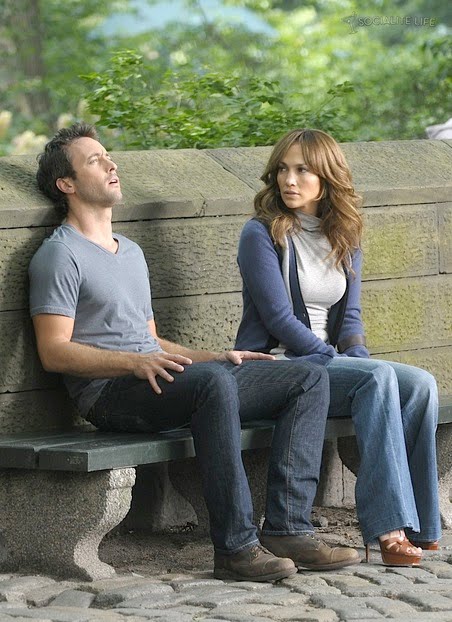
So quick synopsis: Jennifer Lopez's character Zoë is an educated, accomplished pet store owner who decides that since the traditional family track hasn't happened for her, she's going to find a sperm donor and have a child. Then, in what is perhaps the weakest, least cute meet-cute ever, she meets a guy who could be The One but goodammit too late the baby's already in there, festering, throwing a wrench into things.

I want to be quick and painless here; no reason you should suffer as much as I did. Everything about this film is bad. Where to start? Lopez's performance is not good. True, we don't expect it to be, but perhaps if it had been less lazy and perfunctory, this film would have been better. Yeah no that's not true. There was no saving this thing, because it failed everywhere. Lopez's Zoë is loopy in a way that is not at all endearing. I do not care about her and her philanthropic pet store, or whatever it is. She doesn't even seem like someone who likes animals. She has no chemistry with any of the other characters; her execution of the fall-down, get dirty slapsticks scenes falls way short of her Monster-in-Law performance, if that's any standard (but of course, those had Jane Fonda, and that's a lot of help); and in general she's just Jenny - miles from the block - determined to play someone who's having twins just after she's had twins.

She is foiled in her efforts by one of the worst rom-com scripts I've witnessed in a long time. And that's quite the accomplishment. It is hard to separate out the poor performances from the very very very bad script. Take the supporting cast, for example. The best-friend-sidekick, that character who's supposed to be slightly less attractive than the leading woman but attractive enough to have her own relationship to serve as a point of comparison, but not so attractive that she's not credible as the Funny One because everyone knows a woman can't possibly be witty and attractive at once - it's too hard; that woman is there to be funny, and strange, and interesting in some way that the leading lady is too impossibly beautiful to pull off. And obviously, a good actor helps, but you have to write and direct her that way. You have to give her the backstory and the dialogue to be funny and strange, not just stick her in there with her mousy hair and plain wardrobe and expect magic to happen. Every single line from this character, set up though it was to get us all ready to laugh and go 'oh that sidekick!' fell horribly flat. So horribly flat that I started to wonder if I had misread this character altogether. Maybe she wasn't the sidekick. Maybe she was just some weirdo stalker who was going to end up stealing JLo's babies and completely switch the genre to some kind of rom-com/thriller a la From Dusk Till Dawn. It was none of that, just a very bad script and equally bad direction.

Speaking of sidekicks, the leading man got one too. I'm sure if I give you three guesses you can figure out who the actor is. A hint: portly, Black sidekick guy, perpetually played of course by Anthony Anderson, who is not funny in the best of circumstances. But even so, has this guy not earned his stripes, just from prolificacy alone? How long is one to be shoved into that wise, Black counselor, dudebro place? Especially when one has been a part of (granted the worst era of) one of the best courtroom dramas in TV history? Doesn't mere proximity to Jack McCoy disqualify you from having to labour through really awful scripts opposite really awful actors? (But then, especially as a Black actor, I suppose not. S. Epatha Merkerson is as much an L&O institution as Sam Waterston, and brilliant in the role, and she's still hanging out playing bit parts in Lifetime movies. [It may be an insult to Merkerson and the exercise of her own agency to suggest that she doesn't choose the work she does for a reason. But honestly, we all know the constraints faced by Black women who are actors in Hollywood. Man, that was some digression.])

But undeniably the worst part of the film - beyond the atrocious script, the poorly-drawn characters, the yawn-inducing slapsticks, the so-what story - is the character and performance of the leading man, Alex O'Loughlin, who plays Stan.

Let me talk to you about Stan. Stan is an asshole.

From the first moment of our introduction to Stan - the meet-blargle - he comes off as an obnoxious jerk. But by this time we're not even sure we like Zoë yet, so maybe we don't care that Stan is a jerk. Maybe they can be jerks together while we talk amongst ourselves. But soon, Stan reveals himself to be such a thorough jerk that not even our apathy towards Zoë can stop us from hating him. Now, a leading man in a rom-com can be an asshole and still make for a good film. In fact, one of my favourite films featured the most brilliantly-executed asshole ever - Jason Patric's Jay in Expired - opposite an equally inspired performance by Samantha Morton. Not only was Jay layered and wonderfully interpreted while one-dimensional Stan floundered around embarrassingly on screen. But Jay's character and the relationship depicted also rang very true. We cringed when his manipulation and abuse were accepted, but we also laughed at his insecurity and the absurdity of the lie he was trying to perpetrate on Samantha Morton's character; the lie that he was it, and she could do no better, one that she ultimately rejected as she went on to be happy without him.

By contrast, here is what I hated about the message of Stan and this film: here's this woman - successful, happy, with friends and interests and things going on - who decides to have a child. She follows through with her plan, gets pregnant, then meets a man that she's at least interested in getting to know, sleeping with, but perhaps not in anything more. Who knows? it's only been 5 seconds. Of course, once he's in her life, she starts to feel guilty about not telling him of this decision she had made about her own body and life long before he fell obnoxiously into her taxi. So she tells him. And all kinds of whiny, entitled, territorial, paternalistic bullshit ensues. It becomes wholly about him, but this fact is partially obscured by the writers, whose only concern is the old "women who try to have it all need to stop pushing men away, beg their forgiveness and eat some crow" meme. (See: Tyler Perry)

To top things off, Stan has no chemistry with anyone - not Zoë (the kisses are among the worst I have witnessed. Stan is a Really Bad Kisser), not The Black Friend who is unceremoniously thrust upon him, not a single other character in the film. In fact, no one has chemistry with anyone. All the other characters exist on the fringes of the film as props in JLo's vanity project and the story's uncomfortable message. They run helter-skelter around in supermarket encounters, gratuitous, unfunny, labour scenes and other messes. And at the end, we all hate everyone and want the last two hours of our lives back. Except Sookie. We don't hate Sookie, but we do come dangerously close.

Monday, 31 May 2010

Newsclips and quotes [Still working on that unexplained stigma]

(Emphasis mine.)

Chairman of the AIDS Foundation, Colin Brewer, said while the foundation was making progress in the fight, there was still much to do.

[...]

He added that although the foundation provided assistance to those living alternative lifestyles, it did not condone the behaviour.

He also urged those present to "rededicate" themselves to the challenge of eradicating any stigma associated with HIV.

Well. Wonder where that stigma comes from.

Thursday, 20 May 2010

Today, in made-up crimes...

I don't know what the hell wandering is, but apparently it's a crime mostly committed by girls, and can end in STDs and pregnancy. Consider yourselves warned.

Monday, 8 March 2010

International Women's Day

Last year, on International Women's Day, I wrote in support of the work of activists addressing Haiti's high incidence of rape. Today, the survival and well-being of women in Haiti remains high on the agenda of activists in the region and allies all over the world, especially in the aftermath of the earthquake. The women I've spoken to there are more focused than ever on rebuilding their country and their lives, and on continuing to work on securing safe, dignified, productive lives and livelihoods for all people. They inspire me not only to join them where they are, but to intensify my own work in Barbados and the Caribbean.

I see a lot of young women in my neighbourhood, on the streets every day, out and about everywhere, engaged in the business of growing up and figuring life out. And every day I'm reminded of how much there is to navigate, as a girl, and how overwhelming it can become if no one is creating the space needed to get through it all. That involves listening and encouraging their creative efforts and all these great things. But it also involves more tangible support, that has to do with their health care, their sexual and reproductive rights, their education, their safety and economic security. I don't have children. And even though I may at some point, and though I love my friends' children, I need not look that far into the future for my motivation to make things better now. I'm looking all around me, out my window right this minute, at the girls and women who depend on all our support to make their lives better today.

Happy International Women's Day.

Tuesday, 12 January 2010

Has Caribbean feminism failed? Or did it just never exist?

Last week, I sat down with two of my favourite male people, over some Guinness(es?) and some wicked, fried pot fish, to catch up on the happenings. The conversation soon got around to feminism, because these two male people are actually interested, and don't just pretend to be in the hopes that when they ask me "how's work?" I'll just say "You know, it is what it is. Pass the pepper sauce."

So they had some issues, among them my confession that in my work, when I talk about my theories of economics to people who are presumably non-sympathetic - or who at least start out that way - I avoid the term 'feminist'. I do not call my work 'feminist economics' outside my group of colleagues or friends because:

1) It is irrelevant, almost so irrelevant as to be counter-productive. I'm suggesting that in the traditional conceptualization of the economy, there are missing markets, and missing actors. Some of women's work, and some of the consequences of economic policy and activity on women, are rendered invisible, and if we are to obtain a true picture of the economy, maximize its productivity and advance development goals, we need to start thinking about that economy in different ways. This argument hinges on the idea that mainstream economics is lacking, whereas 'my' economics is more complete. To then present my views as 'feminist', to qualify them in this way, only marginalizes them, which is the opposite of what I'm trying to do.

2) It is inflammatory. 'Feminist' is a bad word. This is a surprise to no one. Many people I encounter are eager to distance themselves from what they see as feminist ideology, and are in fact relieved to have that basis on which to reject your ideas. If advancing that ideology without using the F word is going to improve women's access to economic goods, then I'm prepared to use other words.

3) It is not true. Based on the first point, if I believe that an economic model that values women's work and counts it as an economic input is a truer model, then what I do is just Economics, only properly done. (One could argue that insofar as feminism is a belief in the right of women to have political, social, and economic equality with men, all economics should be feminist economics, which is also true. And so we could argue each of those points, and probably both be right.)

This is an age-old argument, and while I call myself a feminist, language is an important part of the political strategy that gets things done. So using language like 'women's rights' and 'equity', and employing methods like first establishing the existence of a problem and then revealing that the majority of those experiencing this problem are women or men or children is often more expedient.

But they thought that I was wrong to do this, and that if feminism was not at all problematic, as I was suggesting, then I should use my work to make it visible as a movement. Because, they said, the feminism that everyone knows, and that men in the Caribbean are so turned off by, has been imported from the US and UK, with all their bra-burning and armpit-hair growing. They suggested that the women's movement in the Caribbean has failed to adequately represent its cause, to refocus the business of feminism within the Caribbean context, and to disabuse people of the notion of feminism as a foreign, outdated ideology. They believed that rather than treat as separate issues like violence against women and sexual and reproductive rights, we should frame them within the larger context of women's human rights, showing the linkages, and in that way, it would all become clear to the masses and we, the feminists, would win. I explained that we had done this, and sometimes it works, sometimes it doesn't. They were not convinced. I suggested that they were considering the issue as already-feminist men, assuming a reasonable, blank-slate audience that does not always exist. Again, they were not convinced.

I had, and have, several responses to this, including the idea that 'feminist', both as a qualifier and a noun, is not strictly tied to 'feminism' as a movement. There's some merit in what they say, as well as some confusion, I think, about what the advancement of women's rights in the Caribbean has looked like, and what it looks like these days. But I wanted to ask you first, readers and lurkers and bears, what you think, before I address these ideas in a subsequent post.

Are Caribbean people really thirsting for feminist knowledge, and have we simply been doing it wrong all along?

Sunday, 4 October 2009

A new look at our Chinese connection

On Thursday, China marked six decades of Communist rule with an enormous, highly-choreographed parade displaying its military might and seeming to celebrate - with its strict formations and careful selection of local spectators - rigid conformity among its people. At least that's how it struck me when I turned my TV on to our one local channel and saw the parade, which was being televised here. In Barbados. On the one local channel.

Granted I was a bit woozy with sleep when I turned on the television. Still languishing in my cable-free existence, I don't watch much TV these days. But every now and then, Channel 8 will broadcast some show offering information that I probably wouldn't otherwise have accessed. A few weeks ago, there was one explaining and seeking solutions for our problems with coastal erosion and the coral reefs that we've managed to destroy, and more recently, a great series of interviews with experts and activists working to reduce the spread of HIV/AIDS in Barbados. So I tuned in on Thursday night in the hopes that I might see something illuminating, and I suppose that's what I got, in so far as the broadcast of the celebrations caused me to realize just how much our 'diplomatic involvement' with China seems to be growing, and to simultaneously ponder what in sky-blue tarnation Prime Minister Thompson and his Cabinet are brewing over there in the Ministry of Foreign Affairs.

Now, Barbados has engaged in diplomatic relations with China since the 1970s, and the two countries have a well established history of bilateral economic cooperation as well as cultural exchanges. Chinese economic funding of capital projects here has been accompanied by the country's provision of its own workforce on such projects, and over time, the appearance of Chinese temporary migrant workers has increased. The population of more permanent migrants has also seemed to grow steadily, but still represents a miniscule proportion of our population. In recent months, the Thompson administration has placed huge emphasis on its efforts to increase the proportion of economic assistance that comes from China. In fact, it appears to be government's key economic strategy for containing the deficit while continuing to grow the economy through the funding of capital projects. Less transparent, however, has been the other part of the equation: what are the conditionalities, if any, upon which this economic assistance is contingent? Is this aid tied to any development indicators? To the reciprocity of economic goodwill via, for example, absorption of an increased Chinese labour force? In short, what does China stand to gain from giving us all this money?

We're not sure, but in the meantime, the current administration has embarked upon some kind of "Embrace China" campaign, in which Thursday's parade was prefaced by the exhortations of the PM to watch the proceedings, proceedings which were clearly meant to convince anyone watching of China's greatness as a socialist nation that has avoided the economic ruin plaguing other countries, and also of the fact that they have large guns, and know how to use them. The spectacle was, frankly, disturbing. And as we saw the odd proximity of flag-bearing children to tanks and rocket launchers and the giant portrait of Chairman Mao floating imperiously across Tiananmen Square, one wondered why the Barbados government was so invested in having us observe, invested enough to send us a special message to watch on television, just as China's President Hu Jintao had sent a message to its citizens. Why China would want its own citizens to watch is not difficult to fathom: as China's economic power and prospecting grow abroad, so too does the backlash against its presence and policies, and with it, the relative insecurity of its people living in the countries on whom it has set its mercantilist sights. Over 3000 Chinese tourists were hurriedly evacuated from Thailand during civil unrest in November last year. And from the coast of Somalia to Papua New Guinea and even nearer home in Xinjiang and Tibet, China has been actively engaged in using military force to suppress uprisings in order, ostensibly, to protect its assets and people. So Thursday's parade was meant to convince not so much its Western competitors as its own people both at home abroad of the government's capacity to protect and its general wonderfulness concerning the country's development. I'd imagine that if a government is really successful, it wouldn't take hours of marching and weapons displays for its citizens to be convinced, but we know that China has never been one for the soft touch when it comes to influencing what its people 'believe'.

But I'm still not sure why even they would care about how 270 000 people on a little rock in the Caribbean Sea perceive them. As it stands, the handful of Chinese living here are not under threat from much of anything, except perhaps idiotic calypso songs, (which when you consider how idiotic might actually be something of an incentive to increase cultural awareness). But apart from that, why insist on broadcasting such an intimidating show of Chinese strength in li'l ole Barbados? Especially without any context or introduction? I have to confess that even as a non-alarmist who has some understanding of Chinese economic and foreign policy, even I was starting to get nervous about possible appropriation of our entire country by the Chinese government. I found myself thinking for a brief, silly moment, "Holy crap...David Thompson done gone and sold the whole of Barbados to the Chinese in exchange for a couple schools and some gymnastics lessons." One imagines (and dearly hopes) that nothing quite so sinister is afoot here, and that this broadcast was nothing more than a type of popularity campaign on which the Barbados government has promised to embark in exchange for oodles of Chinese cash. But this doesn't make the whole thing any less irritating. In fact, it probably makes it more so. And here's why:

The following night, as I looked at the little Channel 8 programming list they air before the 7:00 news, I noticed that slotted in at around 8:30 was some show vaguely called "Chinese Culture". So I tuned in to find a programme featuring a very small-voiced, female narrator describing the virtues of Chinese farming practices, healing techniques, gastronomy and who knows what else. It was a naive little crash course in the tourist's China, looked like it was recorded in the 80s, and didn't say much of anything. By the next night, when an identical show appeared in the lineup, I was starting to get simultaneously confused and annoyed. The series struck me as a silly little propaganda campaign (ack! there's that word) meant to convince us that there's nothing wrong with having China foot our capital projects bill (someone doth protest too much) because they're really cool people who know how to shoot guns and do acupuncture. And once I had again convinced myself that the Prime Minister had not in fact sold us off as a new Chinese colony, I began to feel insulted by this ridiculously superficial and misleading 'education campaign'.

First of all: don't try to handle me. (I've always wanted to say that, preferably while sitting across a boardroom table from Bill Gates or Condoleeza Rice, but this will do.) Don't handpick little soundbytes about horticulture and food preparation and sell them to me as a representation of modern-day China. Not only does it obscure far more important aspects of the historical making of the People's Republic of China as a nation and the way its society functions today, but honestly, it's just a weak, lazy attempt at cultural integration. If I were China, I would ask for my money back.

Second, if people truly have concerns about our dependence on development aid from China, they are more likely to do with the country's human rights record: the Chinese government's restrictions on free speech and the media, independent organizing and religious freedom continue apace. Lack of due judicial process operates alongside the torture and ill-treatment of prisoners, and the country's one-child, family planning policy represents more violations of human dignity and reproductive rights than can be discussed here. After Iran and Saudi Arabia, China executes the most people per capita in the word, including for crimes like tax evasion. (Although if you kill your girlfriend, you're straight; especially if you promise to pay for her. You break it, you buy it, dude.)

This is not to say that diplomatic relations have to be severed in order to take an ideological stand against the undesirable parts of a country's system of governance. In fact, it's often more effective to engage than to dissociate. That is, when you're the U.S or UK or any country larger than an area rug. When you're Barbados, you don't roll up into China and say "you know what, we'd love to take your millions but we're concerned about the status of the Uighurs in Tibet, so let's start that dialogue." No. You say "Ooh millions! Thankees!" Because no one cares. You have nothing to offer and no one cares what you have to say. Your two possible courses of action are: take the money/don't take the money. And while there might be room for negotiation on less important points, China is not taking advice from David Thompson on its human rights record.

So the PM takes the money: there are arguments for and against that. This we acknowledge. But don't insult us by launching a media campaign pretending that China is all economic success and beautiful (-ly controlled) weather, and engaging in your own brand of revisionist/selective education. It's maddening. And stupid. Clearly the PM is not going to grab China's money and then run home to engage in long, televised debates about the death penalty or the war in Tibet. But neither should he gloss it all over with mindless little 'culture shows' as if we can't read, or have no international social conscience. It only makes me angry, and want to further question not only the content of any new bilateral agreements with China, but the general foreign policy skill of Barbados's current administration. Which suggests to me that whatever the PM's goal may have been, the whole thing backfired a little.

Thursday, 1 October 2009

Can we be clear once and for all on who suffers most and worst from intimate-partner violence? Please?

I wasn't going to write about this, because this type of argument exhausts me, but here it is, stuck in my craw, and it doesn't seem to be moving. So onward.

Any discussion encompassing gender in Barbados seems to be permanently stuck on the old "but it happens to men too!" or "men suffer worse!" refrain. And the media seems quite happy to play that tit-for-tat game: every issue must be highlighted as having equal effects and repercussions for men and women, whether this be the case or not; and - I suppose through some naïve interpretation of equality - both 'perspectives' must be given equal column inches and presented with like gravity. Intimate partner violence has become chief among these.

Last week, the Nation devoted pages of coverage to the silent but apparently common scourge of woman-on-man intimate partner violence. Chairman of the Men's Educational Support Association, Ralph Boyce, who has become the self-appointed spokesperson for men's rights, was quoted heavily in one of several articles on the issue:

THERE ARE A LOT OF WEAK MEN IN BARBADOS.

That's the conclusion of the chairman of the Men's Education Support Association (MESA) about men who stay in relationships where they are verbally, physically or psychologically abused by their girlfriends or spouses.

First off, I would venture that further denigrating the character of victims of abuse by publicly classifying them as 'weak' is the wrong tack to take in offering them help. But further, if feels to me as if Boyce is conflating his outrage at violence against men with his general indignation that women should dare to speak on behalf of their male partners:

"In MESA, we have some cases, luckily not too many, where men say they can't come to meetings because their wives say they can't come.

"Or, it is a case where I call a man's home to invite him to a meeting and his wife or woman says he can't come and starts giving me reasons," Boyce disclosed, adding:

"We have some surprisingly weak men in Barbados and the women hate them for it. They call them 'twerps' and twits.

Controlling behaviour is often a serious indicator of systemic violence in a relationship, but I would hesitate to categorize the declining of an invitation on a partner's behalf as psychologically abusive. One gets the sense that Boyce is really saying "listen, man up and put your foot down, and no woman will overstep her place long enough to knock you around." This is clearly an oversimplification of the dynamic of intimate partner abuse. While Boyce asserts that the problem of female violence against men has gone unaddressed because "[w]hat prevented victims from coming forward was the perceived ridicule", he ironically spends much of the article ridiculing men who have been abused, while tossing out vague generalizations like "women like men who are strong."

And he also seems to confuse anecdotal evidence with data:

"One of our members who was doing some research into physical violence told me that a man told him his wife slapped him inside the supermarket in front of everybody and the member asked him what he did, and his response was that he went outside the supermarket and cried. This is a real case," he said.

I'm not sure what to do with that. Are we to be awed by the fact that a man might suffer physical abuse at the hands of his wife? Or that he cried? Or that he didn't retaliate with 'strength', however Boyce might define this. Because for all Boyce's purported rejection of "[t]he traditional belief [...] that the man is not supposed to show any kind of emotion", he seems to subscribe to it himself. Or is this merely meant to serve as evidence that such violence exists? In which case, I, for one, don't need much convincing. I saw one such case, in fact. That is, (and since we're basing conclusions on observed evidence) one case in my entire lifetime as against oh, say, a couple hundred involving women as victims. Boyce, though, is not convinced that the problem is so uncommon:

The verbal and physical abuse is very common. A lot of the time, women initiate the violence against men.

I would love to have that 'a lot of the time' qualified (in a lot of the cases involving male victims, or the DV cases in general?), and this is a huge part of my problem with this kind of irresponsible reporting on the part of people who should know better: a respected and recognizable public figure stands up and, speaking with seeming authority and one would assume the benefit of research, claims that "a lot of the time, women initiate the violence against men", and people run off convinced that not only is violence against women not the immense public health problem it actually is, but that women actually initiate this and other types of violence, and conversely, it is violence against men that constitutes the real danger in the Caribbean.

We know that there is likely to be chronic underreporting of all types of domestic violence cases, among both men and women, but this is not a sufficient condition to deduce that men are being abused as much as women, and it's just that they're not telling anyone because people, ironically like the MESA Chairman, will call them weak. And it isn't even necessary to prove that the abuse is as widespread as that against women in order for it to be flagged as a problem: no one should have to endure abuse, and if we can provide unique support for these men that they might not get from a regular victims'/survivors of violent crime support service, then we should (although I would suggest that given his tenuous grasp of the intimate partner abuse dynamic, Mr. Boyce not be the one to offer such support).

But let us not present violence against women, as the Nation has done by first telling the stories of men who have been abused and then in a subsequent issue those of women (the latter notably in fewer pages), as on equal footing with that against men. It simply is not true, and I'm not sure what purpose it is meant to serve. It has been a hard struggle in the Caribbean, this business of eliminating violence against women, and it seems very little headway is being made. For years, activists and Ministers alike have been highlighting the grossly exceeded capacity of shelters for women and children here in Barbados, while in Jamaica, domestic-related murders jumped 20 per cent between 2005 and the end of 2006 and continue to rise, with women and girls constituting (at least) over 70% of the victims in each year of reporting.*

It would be misguided to allocate public resources meant to reduce domestic violence equally (that is, equally; that is not to say no resources should be allocated to DV against men at all) along the violence against women/violence against men divide, and to lump them together both in our discussion and treatment of the issue is also a mistake. They are simply not the same: the persistent dynamic that keeps women in abusive situations both in homes and communities; its coexistence with sexual violence and women's exercise of their sexual decision-making and rights; the higher HIV infection rate of women which operates alongside a higher care-taking burden than that of men; all these things and more separate violence against women from violence against men. I am all for public resources being allocated to the elimination of all forms of violence against our citizens, but let's keep in perspective who the most emergent victims are, and stay focused in our advocacy to save women's lives.

*Jamaica Constabulary Statistics Department Report 2007

Thursday, 18 June 2009

Virginity scholarships

Salon's Broadsheet today discusses this news of university scholarships being offered to schoolgirls in Biriwa, Sierra Leone who can prove they are virgins. The scheme is aimed at reducing high rates of teenage pregnancy, and is being implemented along with a measure that bans "any schoolboy found guilty of impregnating another student from all educational institutions." Eligibility for the scholarships requires a virginity test administered by a community nurse.

Apart from the fact that a virginity test that examines the presence of an intact hymen is not reliable (a hymen may rupture at any point through regular physical activity and some women are born without them. And I hate that I even have to point all this out in the context of this article), subjecting a young woman to this type of test is grossly invasive and potentially shaming, whatever the result. But further prizing women's virginity and using it as a basis for a reward of education is very problematic. It creates an artificial relationship between the purity of women and their potential for academic attainment. Because even though in this setting, teenage pregnancy may interrupt young people's academic careers, with adequate access to birth control and reproductive health education, sex in itself need not. Even though one may argue that applicants subject themselves to the conditions of the scholarship, we all know the extent to which restrictions in opportunity also mean restrictions in choice, especially in a country with already limited access to education for girls.

And this type of measure also makes no distinction between young people engaging in sexual activity with each other and rape. Victims of rape are of necessity not eligible, so that these schemes not only stigmatize women's sexuality and pregnancy and prize virginity, but punish victims of sexual violence and reinforce the notion that the victim is to blame.

Boys are also being punished for their sexual behaviour, and incredibly, being permanently denied access to education. So while we may want to encourage young people who become pregnant and decide to care for their child to pursue education in order to better provide for themselves and their families, this measure advocates the opposite. It caps the educational attainment and future earning opportunities of boys as a punishment for the 'crime' of impregnating a young woman. I understand the desire to balance the responsibility of child care so that women are not disproportionately affected, but this is not the way to do it, and is essentially counter-productive, since it has the effect of limiting any potential financial transfers of father to mother for the support of the child, whether these transfers be voluntary or facilitated by the State. And if the motivation is to subject teenage fathers to the same 'punishment' as teenage mothers of being kept out of the school system, perhaps the answer is not to punish anyone at all, but to work towards a system that does not convert pregnancy into a lifetime sentence to poverty.

Monday, 1 June 2009

Remembering Dr. George Tiller

I was not going to write about the murder of late-term abortion provider George Tiller in Wichita, Kansas on Sunday. I thought I would leave it to those closer to the horror to come to terms with their own feelings about it, to write about them, to remember the man and his work, and - unfortunately but inevitably - to actually have to defend Dr. Tiller's memory and the value of his work against those who would argue that he reaped what he sowed. I thought I would silently commiserate with the women he helped and whose lives he saved, and with those he would have helped but who will now have no place to go; and wordlessly offer up my thoughts and love to his family and friends.

But I find it difficult to go on with my week here at the Chronicles and in general without making this written statement about Dr. Tiller. And it's because as people who work to secure reproductive rights and health for women in different parts of the world, this act of terrorism affects us all. The same language that has been used to intimidate women seeking abortions and to incite hatred against people like Dr. Tiller who provided them - words such as 'abortionist' (as if he practiced this gleefully as a hobby) and 'baby-killer' and far uglier ones - are also used where we work to obscure the truth, because hate thrives where the truth is hidden. And the truth is that in the US, third trimester abortions are less than 1% of all abortions and must be medically indicated. In parts of the global South, that percentage drops even lower, as the diagnosis and procedures that would allow for life-saving terminations are less accessible. I've embedded the linked video by RH Reality Check below.


So I stand today with everyone else acknowledging the brave work of Dr. Tiller and honouring his memory. And I think the message that needs to be sent unequivocally by government through its abortion legislation and through its prosecution of this kind of terrorism and the language and intimidation tactics that give rise to it, is that this is not a war that will be won with guns. Being shocked and outraged is fine, but that shock and outrage are nothing unless they lead us to swift action to protect the reproductive rights of women, and the lives of those who secure them.

Monday, 13 April 2009

Springing forward

I love my life. Even though it's sometimes hard, it's always mine, largely within my control and full of the wonderful people with whom I choose to surround myself. Sometimes I feel tired, and feel the need to determine exactly what's making me tired, so I can move forward, instead of moving around in circles; and so I can separate the things I can actively fight to change, from the things I might not be able to change but for damn sure won't be a party to, from the things I just have to release and let be.


Today, I'm tired of the definition of masculinity that maintains adult males as men-boys, always having to reinforce among themselves that they are still and always will be capable of attracting 'girls', 'girls' here being grown women that they cast as girly, perpetually young, oversexed beings who can never be complete without a penis. I am tired of phrases like 'stop being a little bitch' or 'are you some kind of pussy?' that equate these vulgar, singular interpretations of womanness with weakness, and are meant to reinforce male camaraderie by making women less than. I'm tired of the films and television shows that glorify this idea of camaraderie, that prize and celebrate the experiences of young, white, heterosexual males as if we are all meant to revel in their partying, beer-drinking, weed-smoking, ass-getting escapades while the experiences of Black men and women are reduced to Madeas and Norbits; and the realities of bright, complex Black men and women (oh will no one bring us another Girlfriends?) remain largely invisible. I'm equally tired of Seth Rogen and Tyler Perry.

And let's not even begin to mention all the straight up fake-ass 'Caribbean' accents that feature American actors who can't even be bothered to at least listen to a Beenie Man interview instead of every other sentence uttering absurdities like 'irie, mon', which no one says except maybe for Rasta caricatures on souvenir T-shirts. And episodes of TV series set in Suriname but featuring a language that can only be described as Trinidadian American English, because Sranan with subtitles would have been too expensive or no one bothered to Google 'Suriname language' before shooting. I'm tired of the Caribbean being exotic enough to provide fake settings for Friends (where 'Bajan' hotel staff are everywhere on set but amazingly none interact with the guests) and soundtracks featuring Rihanna, Shontelle and Rupee, but not important enough to merit the marginal extra effort to research an accent or find a Caribbean actor.

And I am way fed up of the ads suggesting that if your hipbone isn't jutting through your skin, you are not 'ready for summer'. Because apparently fat people aren't allowed outdoors in July, and must remain inside on pain of being electrocuted and having their large asses dragged back in the house and covered in a tarp. Bzzzt! That's called an electrified perimeter, fatty. Now eat your Special K lunch and then drop and give me a bazillion. The sunshine is for the pretty people.

I'm really tired of the term WAG, which conveniently rhymes with 'hag', 'drag' and 'slag', the final straw being a reference to the 'G20 WAGs'. I suppose these women do not merit actual, complete words, since they are in their entirety just the appendages of their far more important male masterspartners.

I am exceedingly exhausted of the women who aim to seek favour and align themselves with men by berating women who do not love porn; do not encourage lap dances and supply their partners with crisp dollar bills for the occasion; have slept with more than 2 and a half men (or women); have made something other than biblical reproductive and parenting choices; or were abused and didn't immediately pack, leave and write a book about it as soon as the bruise stopped throbbing. I am tired of women making claims to sisterhood when they really mean whitesisterhood or whiteAmericansisterhood or Westernsisterhood or sisterswholookandlivelikemehood. I am tired of watching my sisters hop and skip and dance around their relationship issues because they're afraid of pissing a man off and being labelled the angry black or brown or just plain woman. I'm tired of my girlfriends not learning our lessons collectively because we think we're above what happened to our friend next door - above being cheated on or abused or raped or disrespected. Because these things happen to the frigid or the weak or the slutty party girls but not to us. And I'm tired of being afraid to say, lovingly and respectfully, 'this is what I need from you' to my partner, or at least I would be if I still engaged in that ego-stroking bullshit we're told we must practice in order not to offend the overlords and end up (gasp) alone.

And then when I'm tired of feeling tired, I do something to renew myself. I take a shower and look at myself naked to remember who I am without clothes and hairstyles and titles and awards and boyfriends. I visit the communities of women who get what it means to support each other and to agree or disagree without destroying. I talk to my sisters and woman friends; and to my man friends who don't need to throw in a lame come-on to feel like they're men, but who can meet me on common ground, a woman with a heart and a brain and a vagina, and not let the latter dictate our exchange. I regroup, recharge, and remind myself that sometimes being tired is what gives you the energy and joy to continue.

Thursday, 2 April 2009

A right to sound, dignified health care

*Also posted today at BelowTheBelt.

I suspended my work as an economist to, among other things, become the Programme Director of an NGO that I helped found, called the Women's Health Advocacy Network (WHAN). I sometimes get the sense that some people (apart from my family and close friends who are my biggest fans and think me something of a superstar, as I do them) don't understand that: they don't understand creating something because you think it should exist, because it is necessary. The conversation often goes like this:

Person: So what are you doing now?
A_D: I'm a writer, and I work with an organisation called WHAN - Women's Health Advocacy Network.

(The writing part does not register at all. I might as well have said "Oh I'm an eater...and a part-time cougher." So they just gloss right over that part to the other thing that sounds more like a job, with acronyms and such.)

Person: Oh! And whose company is that?
A_D: Well it's not really a company. It's an NGO that looks at issues of women's health and sexual and reproductive rights in the Caribbean, and educates women on their patient rights...how to be agents in their own health care.
Person: Right. And who runs that?
A_D: Well I do. Along with some other very bright women. We started it.
Person: Yourself? But who pays you?

This is where people start to look skeptical and confused. They seem to be puzzled by the notion that I could have the audacity to be dissatisfied enough with the way things are being done to get up off my ass and do something about them myself. They apparently expect me to take a regular job like everyone else, and then spend all my time complaining that I had to wait two hours in the waiting room at the doctor's office, and then another hour waiting naked on his table, after which he spent 30 seconds looking at my vagina and zero seconds looking at my face. Or they expect that if I step out on my own, it should be because I've built an online business or invented some device that I can hawk on QVC, which - don't get me wrong - is never out of the question. Or they also expect that WHAN must be a little group of forlorn women who park our behinds in front of supermarkets clanging our tins for some pennies, rather than the board-run, non-profit corporation that it is.

Now there's nothing wrong with a 'regular' job. I had one, and many people I know have one. In fact, I have one now, it's just that I created it myself because it is necessary, rather than waiting for someone else, someone presumably with more power and influence, to create it and then deign to give me a job. I've decided to first earn - through work I've previously done - and then own, my power and influence. And to seek to grow it on my terms. And also to help other women own theirs. Because that attitude that leads people to believe that I don't have the right to get up and do for myself, as my mother would say, is the same one that has women believing that they don't have the right to demand to be listened to by doctors, and to be treated with dignity and respect. It's the attitude that says that as Caribbean people, as Black people, as women, as Black, Caribbean women, we should only be takers of what is given to us: takers of someone else's job that they've created and offered, takers of someone else's economic policies, takers of someone else's health care that they administer in the way they think we deserve.

I grew up in a time when our mothers were so pleased to be accessing free government health care, that they saw doctors and nurses as gods, and seemed afraid to question them, in part - and this is true of most societies - because they had knowledge our mothers did not have. But they were also afraid to challenge them lest they withhold their care, time and medicine, which many of them doled out as if we were begging, as if it was their own to control, and not the state's. As people have started to do better, and private, paid care has become the standard, that attitude has been slow to change on both ends. Many of us still believe that we're lucky to be sitting in that doctor's office, so we'd better shut up, nod, smile, and try not to cause any trouble. And many doctors still act as if they are gods come down from on high to save the stupid natives from themselves.

Well that attitude is not only annoying as all get out, but it at best potentially delays healing, and at worst, kills people. WHAN now focuses very heavily on HIV/AIDS and other STIs; sexual and reproductive decision-making including abortion; and violence against women. But we were thrust into existence on the basis of patient rights and education, because I, for one, was tired of the assumption on the part of doctors that I had nothing at all to contribute to my own health care, and tired of hearing all the stories from my friends. One of how a doctor failed to diagnose her breast cancer because he saw she was in her thirties and therefore dismissed the lump she had felt; another who eventually almost committed suicide because when she approached her doctor about post-partum depression he asked her why she couldn't just be happy, she had a baby now, and why couldn't she just get over it. And yet another who had to beg her doctor for a prescription to help relieve the symptoms of her genital herpes. Because he said it was no big deal, it's just a sore, and the medication is expensive.

I could go on and on and so much further on. And I know people will sing the old song about patients not being knowledgeable, so doctors assume a blank slate in approaching treatment. In my experience, some doctors don't assume a blank slate: they assume a stupid one. And there is always knowledge to be had from a patient if you use your limited time wisely to get it. In any event,WHAN seeks to work on both ends of the relationship, but primarily to bolster patients' awareness of their own knowledge gaps, to help fill those gaps, and to give patients the tools to make their doctors fill those gaps. You have to know what you don't know, and then you have to claim the right to find out. It is for all these reasons, and so many more, that WHAN exists, works, and grows every day.

Wednesday, 18 March 2009

Is it coming? 'Cause I am

Viv Groskop writes in The Guardian today about women who climax during labour. The writer talks to Amber Hartnell, a mother whose natural, water-birthing process is featured in the documentary film Orgasmic Birth, and who says she did not actually experience pain during labour, but rather, intense [orgasmic] sensations. The film examines such experiences in the broader context of ""undisturbed birth" - natural labour in a home setting, without drugs, or even gas and air."

According to the article, and as one would expect, the notion of orgasm during birth is meeting with disapproval and opposition in several places [emphasis mine]:
The response to the film has been one of both fascination and horror. For many women the idea that childbirth can be orgasmic is at best hippyish and possibly offensive - a notion that at once piles pressure on to women to find pleasure in giving birth, and seems to deny the pain the vast majority experience. One heavily pregnant blogger writes that she "can understand pain being natural in childbirth and letting your body take over and making it as enjoyable as you can. But orgasmic? No. Whoever finds that orgasmic needs help, in my opinion." Another suggests that they "wouldn't like to think my mother had an orgasm while giving birth to me."

I'm not sure why this would be a problem. What does it mean that my mother may have climaxed while giving birth to me? Does this writer feel like she had sex with her mother? Because if we're counting being forced out of someone's uterus, I need to change the date on that "had sex for the first time today! w00t!" entry in my diary.
The film's producer, birth educator Debra Pascali-Bonaro, says a woman's ability to feel intense physical pleasure during childbirth is "the best-kept secret". So well-kept that many women would argue that the phenomenon does not exist. There is debate over whether these women have really been experiencing a sexual climax, or are simply having some form of sado-masochistic response, mistaking intense pain for pleasure. After some critics in the US wrote the idea off as a "fairytale", one of the film's orgasmic subjects, Tamra Larter, a mother of two from New Jersey, clarified that she "felt something resembling an orgasm" and that the sensations she experienced "were something different than sex, but similar enough I feel OK using the word orgasmic."

G-spots were a 'fairytale' too. In any event, I don't see that this precise definition matters, or why we feel the need to invalidate what women say they experience because it makes us squirmy. Is it that we would only like a woman to achieve orgasm during a narrow set of controlled circumstances in which she is 'being satisfied by' a man either directly during partner sex or indirectly while presumably thinking of a man during self-pleasuring? (People who think this way tend to account for lesbian relationships as man-haters trying to approximate the heterosexual act of sex, so men are pretty much central to that orgasm too.) If so, there are some spin bikes in various gyms around the world that may have to be brought in for questioning.

Or is it that childbirth should hurt, g-dammit. Otherwise, without the fear of (i) being forced to give birth (which is the 'children as punishment' agenda that some pro-life advocates advance) and (ii) the accompanying excruciating pain, what's to stop women from having all the sex they want? The earth would descend into madness!

Perhaps some of us are just plain uncomfortable with mixing sex and childbirth. It's not like they are in any way associated with...oh wait.
Women in the documentary have been criticised online for kissing their husbands too much during labour, which some viewers find distasteful.

So in a scenario where people are coming out of my vagina, it's kissing my partner that you find too intimate to watch. Got it. I'd imagine these are the same people who find swearing during contractions unladylike. You would think that further partner bonding during labour would be encouraged.

British birth specialist Sheila Kitzinger, who was also interviewed for the piece, has an explanation for the discomfort people feel over the issue:
"It crosses the margin of decency - which I think is wrong," says Kitzinger, "We're told that sex is different from childbirth. In the same way, it is considered indecent to experience intense physical satisfaction from breastfeeding."

I agree, as the article acknowledges, that orgasm during childbirth should not be held up as some standard for women to achieve, and of course we don't want to encourage the "Well my ex-wife orgasmed during labour. She loved it. What's wrong with you?" dialogue. That would be insane. But people need to get over the policing. If I ever find myself in labour, and happen to climax when all I'm expecting are paroxysms, rings of fire and general torture, then I say bring on the O.
Creative Commons License
This work is licenced under a Creative Commons Licence