Showing posts with label Film. Show all posts

Tuesday, 15 June 2010

The Back-up Plan: The Almost Demise of Sookie St. James

Just the other day I was thinking how great it would be to see Melissa McCarthy onscreen again. Only I didn't call her Melissa McCarthy in my head. I called her Sookie - the best friend from Gilmore Girls? She's great. She was great as Dena in Samantha Who as well, even though she played the same character. But who cares? She could play Sookie St. James in the next Star Wars film and all would still be right with the world.

Well, be careful what you wish for and all that. Shortly afterwards, a friend asked me to see The Back-Up Plan, which made me wrinkle my nose and think 'Really? Are you sure that's what you meant to say?' but turned out that was the only non-ridiculous option at the theaters. At least that's what we thought at the time. I was all set to relax into some harmless mediocrity, perhaps redeemed by an interesting wardrobe or a leading man who wasn't too bad to look at. But then to my surprise: Sookie! Sookie St. James as I live and breathe! Well my dears, believe it or not: Sookie was not enough. And, as it happened, harmless mediocrity was way too much to hope for.

So quick synopsis: Jennifer Lopez's character Zoë is an educated, accomplished pet store owner who decides that since the traditional family track hasn't happened for her, she's going to find a sperm donor and have a child. Then, in what is perhaps the weakest, least cute meet-cute ever, she meets a guy who could be The One but goodammit too late the baby's already in there, festering, throwing a wrench into things.

I want to be quick and painless here; no reason you should suffer as much as I did. Everything about this film is bad. Where to start? Lopez's performance is not good. True, we don't expect it to be, but perhaps if it had been less lazy and perfunctory, this film would have been better. Yeah no that's not true. There was no saving this thing, because it failed everywhere. Lopez's Zoë is loopy in a way that is not at all endearing. I do not care about her and her philanthropic pet store, or whatever it is. She doesn't even seem like someone who likes animals. She has no chemistry with any of the other characters; her execution of the fall-down, get dirty slapsticks scenes falls way short of her Monster-in-Law performance, if that's any standard (but of course, those had Jane Fonda, and that's a lot of help); and in general she's just Jenny - miles from the block - determined to play someone who's having twins just after she's had twins.

She is foiled in her efforts by one of the worst rom-com scripts I've witnessed in a long time. And that's quite the accomplishment. It is hard to separate out the poor performances from the very very very bad script. Take the supporting cast, for example. The best-friend-sidekick, that character who's supposed to be slightly less attractive than the leading woman but attractive enough to have her own relationship to serve as a point of comparison, but not so attractive that she's not credible as the Funny One because everyone knows a woman can't possibly be witty and attractive at once - it's too hard; that woman is there to be funny, and strange, and interesting in some way that the leading lady is too impossibly beautiful to pull off. And obviously, a good actor helps, but you have to write and direct her that way. You have to give her the backstory and the dialogue to be funny and strange, not just stick her in there with her mousy hair and plain wardrobe and expect magic to happen. Every single line from this character, set up though it was to get us all ready to laugh and go 'oh that sidekick!' fell horribly flat. So horribly flat that I started to wonder if I had misread this character altogether. Maybe she wasn't the sidekick. Maybe she was just some weirdo stalker who was going to end up stealing JLo's babies and completely switch the genre to some kind of rom-com/thriller a la From Dusk Till Dawn. It was none of that, just a very bad script and equally bad direction.

Speaking of sidekicks, the leading man got one too. I'm sure if I give you three guesses you can figure out who the actor is. A hint: portly, Black sidekick guy, perpetually played of course by Anthony Anderson, who is not funny in the best of circumstances. But even so, has this guy not earned his stripes, just from prolificacy alone? How long is one to be shoved into that wise, Black counselor, dudebro place? Especially when one has been a part of (granted the worst era of) one of the best courtroom dramas in TV history? Doesn't mere proximity to Jack McCoy disqualify you from having to labour through really awful scripts opposite really awful actors? (But then, especially as a Black actor, I suppose not. S. Epatha Merkerson is as much an L&O institution as Sam Waterston, and brilliant in the role, and she's still hanging out playing bit parts in Lifetime movies. [It may be an insult to Merkerson and the exercise of her own agency to suggest that she doesn't choose the work she does for a reason. But honestly, we all know the constraints faced by Black women who are actors in Hollywood. Man, that was some digression.])

But undeniably the worst part of the film - beyond the atrocious script, the poorly-drawn characters, the yawn-inducing slapsticks, the so-what story - is the character and performance of the leading man, Alex O'Loughlin, who plays Stan.

Let me talk to you about Stan. Stan is an asshole.

From the first moment of our introduction to Stan - the meet-blargle - he comes off as an obnoxious jerk. But by this time we're not even sure we like Zoë yet, so maybe we don't care that Stan is a jerk. Maybe they can be jerks together while we talk amongst ourselves. But soon, Stan reveals himself to be such a thorough jerk that not even our apathy towards Zoë can stop us from hating him. Now, a leading man in a rom-com can be an asshole and still make for a good film. In fact, one of my favourite films featured the most brilliantly-executed asshole ever - Jason Patric's Jay in Expired - opposite an equally inspired performance by Samantha Morton. Not only was Jay layered and wonderfully interpreted while one-dimensional Stan floundered around embarrassingly on screen. But Jay's character and the relationship depicted also rang very true. We cringed when his manipulation and abuse were accepted, but we also laughed at his insecurity and the absurdity of the lie he was trying to perpetrate on Samantha Morton's character; the lie that he was it, and she could do no better, one that she ultimately rejected as she went on to be happy without him.
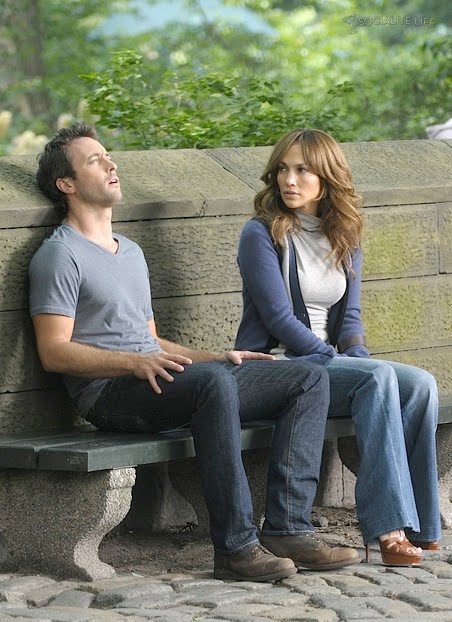
By contrast, here is what I hated about the message of Stan and this film: here's this woman - successful, happy, with friends and interests and things going on - who decides to have a child. She follows through with her plan, gets pregnant, then meets a man that she's at least interested in getting to know, sleeping with, but perhaps not in anything more. Who knows? it's only been 5 seconds. Of course, once he's in her life, she starts to feel guilty about not telling him of this decision she had made about her own body and life long before he fell obnoxiously into her taxi. So she tells him. And all kinds of whiny, entitled, territorial, paternalistic bullshit ensues. It becomes wholly about him, but this fact is partially obscured by the writers, whose only concern is the old "women who try to have it all need to stop pushing men away, beg their forgiveness and eat some crow" meme. (See: Tyler Perry)

To top things off, Stan has no chemistry with anyone - not Zoë (the kisses are among the worst I have witnessed. Stan is a Really Bad Kisser), not The Black Friend who is unceremoniously thrust upon him, not a single other character in the film. In fact, no one has chemistry with anyone. All the other characters exist on the fringes of the film as props in JLo's vanity project and the story's uncomfortable message. They run helter-skelter around in supermarket encounters, gratuitous, unfunny, labour scenes and other messes. And at the end, we all hate everyone and want the last two hours of our lives back. Except Sookie. We don't hate Sookie, but we do come dangerously close.

Thursday, 14 January 2010

A story to share from Haiti

Some of us in the Caribbean region who have links to Haiti, a place we've worked, lived and visited, have made many friends there over the years. Among those friends are the amazing people at the St. Joseph's Home for Boys in Petionville. We heard yesterday that the Home was one of the collapsed buildings in the capital, and as we seek more information about the Home and many of our other loved ones, two friends and colleagues, Tonni and Cynthia, share this letter:

Dear Friends,

Many of you may remember in 2003 - 2004 Tonni [redacted] and I went down
to Port-au-Prince with only our cameras and dreams of making a
documentary on the reality of Haiti, one that focused on hope and not
misery. We were so very fortunate to have made incredible friends on
that journey, who not only sheltered us from harm but truly opened
their hearts, to share their stories and vision of hope for Haiti.

The news of yesterday's earthquake has devastated us, especially in
learning the St. Joseph's Home for Boys, which we featured in the
film, was one of the many buildings that collapsed. While both our
instincts are to get on a plane to Hispanola with camera in tow, to
help, and to tell the true stories from Port au Prince, we recognized
that what we needed to do right now is to share the one we already
documented. We spent a couple of weeks at St. Joseph's Home for Boys
in Petionville, Haiti (on the hilly outskirts of the capital),
capturing on film the lives and talent of these young orphaned boys.
Our documentary, Seeking the Soul of Freedom, which was inspired by
the Bicentennial Independence Celebrations, is a collage of intimate
stories of reconnection and hope for Haiti, and her people.

To watch the film visit
Part 1: http://www.youtube.com/watch?v=OyMhv_noP4s
Part 2: http://www.youtube.com/watch?v=RJ4EHy08LVM

Because it is 15 minutes we had to break it into parts

For more information on St. Joseph's Home for Boys visit:
www.heartswithhaiti.org
You may also want to check out HaitiXchange.com for additional
information on the earthquake and all things Haiti

With all our love and prayers for Haiti,
Cynthia and Tonni


Wednesday, 19 August 2009

Nia Vardalos should blink some time

I don't have cable these days. I know. Gasp, right? But the upside of this, depending on how you look at it, is that I get to catch up on lots of films that my sister rents so that we don't have to keep watching Fun School reruns and Mark Lorde concert clips on Channel 8. However much you may love "My Country to Me", watching a man dressed in a red and white suit sing it for the 65th time would break anyone's spirit. So when my sister brought me Nia Vardalos's most recent film project I Hate Valentine's Day, I was relieved, if solely for the reprieve from horrifying red and white ensembles a film by this name would likely offer. Well, 'red and white' there was not but 'horrifying' there was by the non-blinking eyefuls. Why does Nia Vardalos not blink? Actors need to blink, right? I mean...she's blinked before. I'm sure she did it once or twice in My Big Fat Greek Wedding, or maybe her supporting cast - who really carried that film if we're being honest - were so brilliant, I didn't notice that the woman is incapable of blinking.

Ok well now I've gone and said 'blink' so much it sounds like gibberish, but Vardalos's performance was cringe-worthy: straight out of the Clive Owen School of Wooden Acting and Weirdly Robotic Inflection. The character she drew was so artificial and unlikely that you felt you were watching Nia Vardalos doing a really bad impression of an insufferable, delusional, know-it-all, pretentious friend/neighbour/colleague who thinks she's fooling everyone she has it all together, but is really just a transparent mess. It's as if she watched Audrey Tautou's Amélie or Sally Hawkins's Poppy and wondered "Can I do this? Can I be this beautifully naïve, refreshing, unpredictable, sage, wisecracking, free spirit that everyone either wants to be with or wants to be?" Turns out: not at all. But hey, at least now she knows.

In I Hate Valentine's Day, the annoyingly predictable tale goes thus: Vardalos's Genevieve is a Manhattan florist who "abides by a strict five-date-limit with any man, [then] finds herself wanting more with the new restaurateur in town", played by John Corbett. I'm not sure why they cast Corbett as Vardalos's romantic interest a second time, except perhaps they thought it safe to stick with someone with whom she has chemistry; in which case they were very mistaken. Corbett's approach to romantic comedy is such a cutesy, simple(-minded), every-man style, that he needs a leading lady with some edge: someone - like Carrie Bradshaw - who will break up the monotony of his 'perfect guy' shtick. In MBFGY, the cast was so full and the pace of the film so frenzied that he worked as a romantic lead. In this vanity project of Vardalos's, in which she clearly thinks she and the ridiculous character she has fashioned are enough to thrill us all, Corbett just doesn't work. She's a contrived buffoon, and he's a natural buffoon (in his gentle giant kind of way that can be charming but so was not here), and between them, they managed to suck the chemistry clean off the screen.

Well, not just them. They have some equally ridiculous help. Genevieve has two gay sidekicks who work at the flower shop with her, prancing around like little elves with predictable questions and quips carefully (but poorly) crafted to elicit Genevieve's story, reveal her character and advance the plot. It's How Not To Write A Screenplay 101. The character of the gay best friend, tired though it may be, can work, since gay best friends do exist in real life. But perhaps it would be useful to meet some actual gay people. Because with Vardalos's flat, uninteresting, stereotypically oversexed versions of the gay man, I can't believe she actually knows any. Or maybe she just shops at the same Weak Stereotype store as the He's Just Not That Into You people.

But as if they weren't enough, Vardalos doubles up on the minions with another ragtag and completely random band of accomplices who meet in a neighbouring coffee shop at regular lunchtimes to dote on the fabulous, still unblinking Genevieve and drink from the fountain of her boundless romantic wisdom, (which, it turns out, isn't very wise. At least let the audience discover the error of the hero's ways over the length of the film. Don't make her philosophy so obviously ridiculous that it's clear she's bound to fail.) Included in this group are SNL's Rachel Dratch and 30 Rock's Judah Friedlander, both of whose comedic scope is dwarfed by the puerile dialogue. Zoe Kazan, poor thing, would be right on the doorstep of brilliant if she weren't trapped in this humourless mess, but at least we know she's one to keep watching. We have no idea whence this strange group of friends came, what they mean to the hero or, frankly, who the hell they are, and if any of them were remotely interesting, we wouldn't care. But with the little entertainment value they offer, we're left shaking our sticks at the TV, mumbling "Why are you here again? Go away!" And then it becomes apparent why they're there: without them, who would comprise the Superfriends team whose escapades would throw our stubborn lovers together? In Notting Hill, it was thrilling and hilarious. In this film, it is formulaic and irritating.

The world these people inhabit is not real, and not conceivable. It's Stars Hollow on uppers, but with a lot less wit and none of the creativity or credibility. Everyone seems forcibly happy, but it isn't infectious, as a film of this nature should be. Too much energy is spent on Vardalos's ineffective, rogue romantic Genevieve, and very little is spent on anything else. The back story - her father cheated on her mother and now she fears commitment - is laughable both in how it is revealed to the audience and in its lack of imagination. We all knew Nia Vardalos was no actor, and now we're assured that - beyond familiar subject matter as in MBFGW - she's also neither a writer nor a director.

Tuesday, 9 June 2009

Star Trek reviews and the lying liars who lie


The trailers for the recently-released Star Trek film barely registered with me. There were flashes of beautiful, young people, several explosions, bits of camp dialogue, and I thought: "Star Trek this is not. All this is likely to be is a typical, silly, summer blockbuster hiding behind the Star Trek name to make some cash." Not even the casting of Zoe Saldana as Uhura was enticing me. But then out came the reviews hailing it as true to the Star Trek culture. Trekkies will love it, they sang, amidst a chorus of general praise and adoration. Of course I couldn't read the reviews in depth, for fear of spoilers, but I had all I needed to give the film a shot.

And how wrong had I been in my original appraisal? Why, not wrong at all.

I am of the The Next Generation generation, and watched the original Shatner/Nimoy series to get some context. Any true Star Trek lover must, of course, understand its origins, but Picard and crew were my Star Trek. Watching the older episodes from the original series, you can see how Gene Roddenberry's creation and conceptualization of a universal peace-keeping and humanitarian task force operating in a future universe - with all the moral complications and scientific advances that would allow - was genius and pioneering in 1966 when it came about. But to a TNG Trekkie (and I use that term loosely. There were no conventions in my part of the globe. I was simply a die-hard fan), Shatner's Kirk was a little melodramatic to Patrick Stewart's Picard, and twenty years of developments in cinematic technology and makeup made TNG a cooler proposition to a 10-yr old at the time. One also got the sense that by this time, the writers and creators were more at home with the world they had created: TNG had a greater sense of fluidity that made you think this world might exist even as you watched. Still, whichever your Star Trek poison, the show had a definite culture of intrigue and excitement, yes, but within the principled, disciplined world of Starfleet, which, frankly, made it all the more intriguing.

In Star Trek the movie, all that goes out the window. And this might make sense to some. After all, the film is meant to chronicle the early days of Kirk and his crew, and there's nothing to say that the glory days of the USS Enterprise were not borne of a power struggle between its brightest minds. But what a farce of a power struggle this, and indeed the entire film, turn out to be. There are so many disappointing elements, I can only touch on a few, after mentioning some of the things the film did right. (This part shouldn't take long.)

First, it's a great story. To convey how great a story without important spoilers is difficult, but when you combine generations of genius Humans and Vulcans, self-sacrifice in the face of apocalyptic destruction, time travel and heroic missions aplenty, how could it not be? And the casting isn't atrocious either. Zachary Quinto makes a credible young Spock, even if his intensity belies the painfully average dialogue; and Bruce Greenwood is the Captain (Pike)! I love me some Bruce Greenwood. The man makes made-for-TV movies worth living for. Simon Pegg is a refreshing Engineer Scott (thank God for someone in this film who understands comic timing), and Zoe Saldana could have made a fantastic Nyota Uhura if someone had remembered to write the actual character into the screenplay, instead of just the name.

Second, the bad-guy concept is almost flawless. Unfortunately, conceptualizing a kick-ass bad guy and then through poor dialogue, inadequate face time and what seems like misguided direction turning him into an 'also-there' is a pretty significant flaw. Nero, played by Eric Bana, is a rogue Romulan - dark, brooding, bloodthirsty and covered in tattoos - in command of a seriously awesome, terror-inspiring ship, the Narada. He doesn't give a crap about rules of engagement or anything smacking of common decency: not as refined a nemesis as The Borg or even the Cardassians who can be brutal and almost genteel at once, but still, worthy of some development. Alas, there was none. His dialogue is pretty weak. He's all snarl really. And while you expect to be terrified by this unprincipled Romulan seeking revenge, he pretty much just whimpers to his demise while you look on unimpressed. This was supposed to be the 'what they did right' part, I know. But the line blurs.

The film also makes use of a nifty little device: red matter, which allows them to take this seemingly innocuous little thing with incredible destructive power, and create very cool scenes of annihilation. The problem was, they didn't slow the annihilation down. When everything is blowing up everywhere, destructions of entire planets - billions and billions of people, we're talking - need a little time to create effect. You can't just drop it in there among run-of-the-mill torpedo explosions and general heroic somersaults and expect the film to have any pace or build any anticipation. And of course, this film failed to do that.


Now, onto the things I found bothersome. I'll try to make quick work of these. First, to the most disappointing for me: Zoe Saldana as Uhura. Here's what I was glad to see: she was a top cadet, she was assertive and didn't feel cowed by her relationship with Spock into being shoved aside in the interest of propriety, we were told exactly what she did on the ship instead of her just seeming like a random ensign with a receptionist's headset (the original Uhura was a communications officer before being promoted to Lt. Comm. and then Commander, but somehow, in those early episodes, she seemed like an intergalactic receptionist to me. Her presence was, of course, nonetheless important for other reasons, but those stretched beyond the confines of the story) and she got to use those skills in saving the galaxy and all that. Here's what I wasn't so thrilled about: she was a role, not a character. Uhura I felt had one dimension. She was to be the woman in the film who was not maternal, and was to represent another part of womanness: the fearless, educated, unimpressed by random flattery type of woman. And she did all that. But she did that without having her character well developed. She was really a paper tiger; and I didn't actually mind her stripping down scene and the fact that she wore miniskirts. I felt it was real. Women high-achiever types are also sexual and attractive: that's fine. In fact, that's great. But at the end of it all, she was really just Spock's girlfriend, wasn't she? And that worked well for Spock's character - it made him seem reachable and helped make us care about him. But Uhura as an individual fairly disappeared into yet another woman who, like Kirk's and Spock's mothers, was just rooting for a man to survive. And I get the impression that any individuality we saw was all about Zoe Saldana: about her great screen presence as an actor, and not so much about the dialogue, depth and direction given to the character that had been envisioned as Uhura.

Next, who on earth was Chris Pine in this thing? Certainly not Captain Kirk. I did not like this man. He was too many parts entitled, spoilt little shit and not enough parts eventually heroic Starfleet captain. I did not care at all about his character. He could have perished at any point and I would not have felt lost about where the story might be going. And apparently in Abrams' conceptualization of Starfleet, seniority and experience mean not nearly as much as they do in the Starfleet the rest of us know. People are promoted to First Officer and Captain at the drop of a hat. Kirk himself simply skipped on board to become a cadet as if he were catching a ride to the bus station, and yes his father was a hero and that meant a whole heap, but it contributed to the overall effect of "this is Kirk's world, the rest of us just live in it". And that was not attractive. We get enough of the privileged, sexually adventurous, all-American White boy image in so many other films. Did they really need to make Kirk this as well? Yes, I suppose he was meant to seem troubled. That's why they gave us that wholly gratuitous car chase scene thrown in the middle. But he didn't seem as tied to and affected by his past as, say, Spock was. And they could have made him a devilish character while still making him a bit sympathetic.

My overall impression of the film was this: it was not Star Trek. And it could have been; it would have been better served by being Star Trek. There was none of Roddenberry's nuanced treatment of human intimate and political behaviour (after all, it's all a metaphor for humanity) and the exploration of what our future psychologies might hold. Even among the explosions this was possible, but was absent, and left a shell of a film. And further, even on its own, without the Star Trek legacy to uphold, it was not a good film. It suffered from a main character who did not seem of its world, from dialogue that did not distinguish it from any other pedestrian action flick, and from the glaring under-development of its characters. And it's such a shame too. Because this was an epic story which, told differently, might have been one of the greats.

Friday, 29 May 2009

Drag your butt to see Sam Raimi's new horror flick

It's been quite a light posting week. It seems my body has been taken over by the soul of someone fabulous and in high demand. I've had things to do, y'all! What an odd sensation. But I did manage last night to see Drag Me to Hell, the Sam Raimi-written and directed horror film that I've been looking forward to for weeks. I'm starved for a good horror flick. They just don't make them like they used to. And if I have to sit through another Hills Have Eyes-style remake foisted upon us by people who don't think you need an imagination to make movies, I'm going to pluck my eyeballs out and eat them with Marmite. (Incidentally, they're also remaking the film that is my standard answer to the question "What is the most disturbing thing you've ever seen?": Last House on the Left. Is it just me or are the horror films people seem most eager to remake those with long, elaborate, almost celebrated scenes featuring the rape and torture of women?)

But Drag Me To Hell feels new, fresh and exciting from the get-go. It's comedy-horror at its finest: even the parts that are clearly meant to be (slightly) camp and hilarious still kinda scare the crap out of you. And Raimi is not afraid of using gore and bodily fluids to up the ew factor, and as a metaphor for the ugliness of evil. He does this masterfully. The spewing forth is not gratuitous; it is integral to the image of just how base Raimi's imagined underworld really is, and of the extent to which it represents the worst, most horrifying alternative reality we might imagine.

Everything in the film is sharp and largely-drawn. The dialogue is crisp, snappy and economical, mirroring Raimi's entire approach to this film: nothing in excess. The backgrounds and props - doors, tables, buildings, natural surroundings - are all expertly used and personified to create the terror and drama of the story. Characters are kept to a necessary core, and the casting is more than credible: Alison Lohman is the wide-eyed innocent and central victim Christine Brown, who is at once vulnerable and hilarious (there's not much ha-ha in the dialogue, but Lohman's face and delivery are made for comedy, and manage to convey the absurdity of a scenario with no need for the spoken word); Justin Long surprised me at first as Brown's doting partner Clay, especially since his mumbling smugness tends to get on my nerves, but then I got it: Clay needed to be funny enough to carry the comedic content, but taken seriously enough that his problem-solving ability and commitment to Christine could drive the drama. So subtle rather than bumbling comedy was necessary. And Long does this well.

The best thing Raimi could have done for this story, and did...um...do, was not to prolong its brlliant conclusion. So in keeping with that spirit, I'm not going to prolong this assessment either. Go watch this film: it's a wonderful, fresh, neatly-packaged little horror flick that you'll be glad you saw on the big screen.

Monday, 18 May 2009

Are women really jonesing for Angelina?

This post is about sex and attraction. It contains some profanity and reference to genitalia. The references are by no means scandalous (ok maybe by some means), but if you're shy about 4-letter words, consider this your warning.

So yesterday morning, via The F-Word Blog, I came across this post by someone called Bitchy Jones (BJ). And I imagine Lynne at The F-Word linked it because she agreed and found it brilliant, as her title "Bitchy Jones is onto something" suggests. But while this BJ person may have a general point, that is, she may be correct in part, I find the overarching message of what she asserts a steaming pile of doodoo. And this post is to explain why.

So she, BJ, is at a party.

The talk is, as it often is, of popular culture. Celebrities we’d like to fuck. We, are seven or eight of us at a table, urbanites, almost exclusively thirtysomething, artsy professionals – basically, if you handed any of us a latte we would drink it – and then one woman, a good friend, says, yeah, but we’d all fuck Angeline Jolie, right?

And she is annoyed by this because:

It is because the highest compliment you can pay a woman is to proclaim that you find her fuckable.

Always and forever and as simple as that.

If you admire a woman and like her, if you find her witty and attractive, if you like the way she thinks, well obviously, you want to fuck her. Because if you were a straight man, that’s where that would lead. But if you’re someone who isn’t sexually attracted to women, you might think you are feeling that too, you might even feel that you are insulting that woman if you don’t want to sleep with her (dishing out the ultimate insult by calling her unfuckable).

Now I get some of what she's saying. First, the notion that we should all want to have sex with Angelina Jolie because her exquisite beauty surpasses personal taste is, in fact, annoying. And tired. And premised on an imposed European standard of beauty that just induces my "Oh give me a big, fat, nougat-filled break" eyeroll response. Angelina Jolie would not be my bag, and don't tell me that I'm in denial. Because as a black, Caribbean woman, surely you can understand that were I attracted to women, a slight, pale, White woman, lovely though she is, might just not be what gets me purring. So I get that part of BJ's meandering diatribe.

I also get the notion that it sometimes slips into our vernacular to - in the way we offer praise - reduce ourselves to what has been determined as women's most important worth. That is to say, we want to convey our thorough admiration for someone, man or woman, and the best we can do is to claim that we love him, or we want to marry her, or we want to have his babies. The commentary in those statements is that the highest praise and prize we can offer is ourselves as lover, wife, mother. Our verbal, intellectual praise or support is not enough. So that it's alright for a man to say as his highest praise "Oh I really support Obama's agenda. He's the best President the United States has seen in my lifetime." But we as women feel forced to say "Obama rocks. Seriously. I want to have his babies." And I get how it might happen. We're being a little facetious; we find it funny; and we don't really examine where it's coming from.

BJ takes it a step further, and suggests that when straight women make this kind of statement about other women, we are not just reducing ourselves to our sexuality and value as objects to be f*cked, but we are reducing those women as well.

[T]his I’d-so-sleep-with-her phenomenon is pretty much just a side shoot from the whole damn dirty deal where women are mainly for fucking and generally supplying sex and men are the choosers and enjoyers of that sex. And also the whole thing that every piece of expression of anything ever should be expressed in the kind of terms and ideas straight men would use, as if that is some kind of default language because straight men will get confused if you don’t because they have never learned anything else, and they’ve never learned anything else because they are the default so they don’t need to.

Well, ok. Except, your example of Angelina is a little weak if this is meant to be your point. Because really, while Angelina is very civic-minded and activist, her main product as actor and public persona has mostly been as a beautiful woman, not as a politician or writer or even, dare I say, as a brilliant actor. So it is, I think, reasonable to say that those women who say they want to sleep with Angelina are not doing as much reducing of her person to the mere sexual as say, those who say they want to sleep with Ruth Bader Ginsburg. I don't think this particular Angelina desire is based on the idea that in order to express your admiration for someone's work or ideology, you have to do so in language that men have invented and we have all appropriated. I think that these people probably do feel some kind of physical attraction: perhaps to look like her, if not to f*ck her. (Glory knows they couldn't possibly like her pouting snarling acting.)

And BJ includes a kind of cowardly caveat toward the end which, I think, she should have led with, or at least paid more attention to. And it is this:

I know this post can be read as somewhat, uh, dismissive of ideas of sexual fluidity. I do appreciate that there is a whole Kinsey scale and everything. And that wherever you might think of yourself on that scale it isn’t fixed for life, but I didn’t want to clutter up my beayootifuel writins with endless qualifications about how this might not apply if you are bisexual or some other kind of self identified sexual lucky dipper. But sexual fluidity can be used to wash away women’s own sexual identities. Too much fluidity, too much choice, ends – bizarrely – in homogeny.

The post is dismissive, and condescending, and patronizing and insulting. And even the disclaimer above is not much better. Because the writer is telling women: "wherever you may think yourself on the Kinsey scale, if you're straight, you probably don't relish the notion of licking Angelina's clitoris. You may think you do, but you really don't. I know." And even with a more generous interpretation, the disclaimer is meant for what she imagines are the small minority of self-aware, not-strictly-heterosexual women to whom her analysis does not apply, as against the misguided, staunchly heterosexual masses of us who can't express admiration except on men's terms.

And she is also telling us that we can't distinguish between admiring someone and wanting to sleep with them. Because we get confused, you see. We don't know what our little pink feelings are all about. And I find that anti-feminist. Yep. I done gone and used the A word. So bring it.


Because I am able to distinguish and articulate my admiration of Rihanna's red carpet poise; and Aisha Tyler's hilarity; and Michelle Obama's eloquence; and Cate Blanchett's acting, as completely separate from the fact that I think Maria Bello has a beautiful mouth and Zoe Saldana is gorgeous and Jennifer Connelly is striking. The former I admire and respect for their talent, and can acknowledge that they're beautiful, but there is no level of physical attraction there. The latter I honestly find hot (not that they're not talented as well), and while I might not want to lick their vaginas because vaginas are not my bag, I can acknowledge that were I in their presence, I might pay attention to a little more than what they had to say. Granted, I've probably only stuck my toe out of Category 0 on the Kinsey Scale, but I own that. And my brain, female though it may be, is able to make that distinction. And let's not forget that a large part of physical attraction is tied up in the non-physical. I might be physically attracted to a man not just because he's pleasant to look at, but also perhaps because he's good at what he does, or seems kind, or speaks well. Might that not be what's involved in women - who identify as straight but feel a bit of loin-stirring for some members of their own sex - expressing their desire for other women? The factors of sexual attractiveness are not as black and white; as talent vs. f*ckability as BJ would suggest.

At some point BJ also half-jokingly suggests an either/or situation, as if to say "STFU no way you straight b*tches would sleep with Maggie over Jake [Gyllenhaal]!" Well that's hardly the point, is it? Since I'm straight, my preference for sexual activity is with men. A woman I might (and this is the hypothetical 'I' so please don't flood my Inbox with oh em gees about my sexuality) want to kiss or fondle or look at or masturbate over, depending on who I am. And I don't have to refrain from those feelings because you have determined that I have to be firmly planted at 0. Yes, I saw your "but I don't mean youuuu" disclaimer, and I ain't buying.

So while I do think we could all benefit from checking ourselves if we're given to using language of admiration that reduces both admirer and admiree to our worth as wives, mothers, lovers and nothing else, I also think that we need to be careful not to invalidate people's true feelings and experiences with our angry theories. The women-are-hot, frat-party, lesbian makeout dynamic among young, straight women is tired, yes. But seeking male validation is not always what's behind expressions of women's sexual desire. If you don't want to f*ck Angelina, then don't you f*ck her. But some of those who say they want to actually do. So I see some value in some of what you say, but in general, just stop policing everyone's sexuality. It must be exhausting.

Friday, 8 May 2009

And finally, a bit of musical nostalgia in honour of Mother's Day

So my mother got us the Little Shop of Horrors video back in the day, and she, my sisters and I watched it together somewhere between 9 172 and one meelion times. The following clip was one of my favourite parts, because even though "Feed Me" and the crazy dentist bit with Steve Martin and Bill Murray got all the attention, Skid Row had all the vocal chops. Tichina Arnold and Tisha Campbell-Martin are so much more than Pam and Gina in this film.

I know every part of this production: every single lyric, bit of dialogue, harmony. It gave me pleasure. My mother would sometimes come into the front house (that's 'living room' for you outsiders) and say "Want to watch the plant?" which of course meant the film. And duh(!) we always wanted to watch The Plant. Who wouldn't want to watch The Plant? So watch this bit of The Plant with me. Sing it, Gina:

Monday, 20 April 2009

In defense of my right to like sports and Guinness: Part 1

Happy Monday! Oxymoron, you say? Not this Monday. The sun is shining today in London, and that's always cause for celebration. And it's real sunshine too - with actual warmth. Not the kind of vague, distant glow you tend to get here, as if the sun had been on a bender the night before and is up there lying on its couch, drinking Andrews and grumbling 'What do you want from me? I'm here aren't I? This is the best I can do right now!"

So here I am, raring to go following a weekend that was actually restful instead of just an extension of the work week. After I left you on Friday, I did rewatch Nacho Libre, whose song about why Ramses is not dancing at the party is still as genius as I remember. What I hadn't remembered was the random, sex-starved fat girl who eats all day and is too hideous to get a man so she has to literally crawl on her hands and knees to cut men (and Esqueleto) off at the pass, trap them and have her way with them. Aren't people tired of writing this character? Because I sure am tired of seeing it. You know, this might just be a rumour, but I'm made to understand that fat women can actually manage to find willing partners for sex if they so desire. It's one of those ideas that's so bizarre it might just be true.

Then on Saturday I went with my favourite DJ (we'll call him DJ because we have wild imaginations) to Camden, where we ate a mountain of vegan food, walked all around the market, sampled overpriced chocolate (and in his case, also a giant, jelly Smurf), and drank Guinness over a conversation about the quietly re-emerging notion that women who say they like sports are just lying to appear cool for men. That's right, folks. Join me on a journey back to the fifth century.

A few weeks ago, a woman at a message board where I post made the extremely insightful declaration that women who say they like (i) sports and (ii) Guinness are not sincere, but rather involved in an elaborate deception aimed solely at hooking themselves a fella. Given that I've been watching cricket since I found eyes in my head and consider Guinness the best food on earth, I am about to shake the foundations of her very existence. But it's not just anonymous message board lady. More and more, throughout this year's Premiership season particularly, it has seemed as if greater numbers of people are choosing a team and jumping on board. Apparently, this type of activity is frowned upon, especially - or only - when the people in question are women. DJ has been noticing it too. In fact, he brought it up, telling me about a guy he knows who is peeved to within an inch of his life when women dare to interject in sports conversations, because they're only johnny-come-latelies doing it to seem cool, and have no natural propensity to understand sports, no genuine interest in it, and nothing to add.

Now what strikes me as particularly hilarious about all this is that the man in question in DJ's story is from Barbados, just as we are. And in Barbados, we play a little of everything, but the only major sport in which we have a legitimate international presence is cricket. That means that support for teams in most sports is not home-grown, based on location or other traditional markers of loyalty. So most sports fans out there fit into two categories: they started playing the sport and were naturally drawn towards its highest exemplars on the international circuit; or they just happened along one day and decided to start watching because they found it entertaining. Neither of these groups, and particularly not the latter, has any kind of monopoly on fandom. Because if the fandom of the women you criticize is artificial, then surely so is yours, since you are not from Manchester or Liverpool and have no reason other than whim or circumstance for the team with which you are aligned. Just because someone is turned onto a sport after you have been doesn't make their admiration of it any less valid. The portal has not closed. New fans are born every day.

And the sports themselves have gone through trends in popularity. When I was growing up, it seemed like none of my peers cared or talked about cricket. The cricket team couldn't pay people to come with them to away matches, get-out-of-class-early pass be damned. NBA basketball was huge, as was track and field. Now, as with several other things, people's scope of interest is growing. And sport trends are changing. Basketball will always have its fans, but football is becoming that sport: the one that everyone has a team in. This is the way, and you don't get to pout about it because some woman dares to share an interest that you think you have dibs on as a marker of your manhood.

And I'm not sure what makes these particular men, some of whom have the agility of porridge and whose most energetic exploits to date are a game or two of Snakes and Ladders, any more disposed to appreciating sports than women are. Agility, strategy, speed, raw skill, camaraderie, politics: these are all aspects of sport that women appreciate. There are three major sports that I follow closely and enjoy: cricket from about the age of 4 introduced by my dad (who incidentally learnt from his mother); tennis from about age 11 introduced as part of the school programme and aided by a good friend at the time who would become a longtime partner; and football from about 12 years ago when I started playing competitively. And to be frank, I've never been inclined to talk to most men about sports. And here's why: I'm not interested in being fodder for your masculine self-affirmation; what I'm after is a real, analytical conversation. So if you can only quote me all of Michael Ballack's defensive stats and tell me how many eggs he had for breakfast on the day of his last match with Bayern, and that is your sole 'argument', then you can move along. I can memorize stats too. That's not what my love of the game is about. And I've found that quite a few men who have come late to following a sport, but who of course are not questioned on the validity of their support, often hide behind statistics, and use them to shout others down before the others realize that in fact, the shouter only discovered what 'offside' was yesterday. Incidentally, most of the men with whom I enjoy a heated sporting debate tend to be secure, well-adjusted people who don't fancy using conversation to try and surreptitiously bully women into accepting their 'rightful place.' Funny how that happens.

Now the whole 'women in sports' dialogue is complex, and there are certain things I'm not discussing here. I am not debating whether statistically more men than women follow sports: I think there is a discussion to be had on how we might express interest differently so that women's interest is sometimes not acknowledged as such, but I feel safe in saying that the number of men I know who enjoy sports is greater than the number of women, although among my Barbadian friends, with our cricket legacy, that gap starts to close somewhat. I am not debating whether women's professional leagues are as entertaining and therefore should attract similar levels of investment as men's. I'm contemplating a follow-up post in which I might address that. And I'm not saying that there are no women who have ever said, jokingly or otherwise, that they only watch football to see men's legs, or baseball for the tight pants. This is something I also want to come to later because when I started this post the sun was high in the sky and now it's almost dinnertime. The thing is way too long. But this is about the ludicrous notion that if you meet a woman who supports a given sports team, odds are, she's lying and is just saying it to seem cool (beyond the extent to which we all use knowledge of competition as a point of social engagement with other men and women). We know you would like to believe you're that central to our lives, but the plain truth is, you really aren't.

Friday, 17 April 2009

Prelude to a failure and stretchy pants

My dears, I have a confession.

On some days, like today, when I have had very little sleep the night before and have been racing madly towards a deadline, and it's the end of a long week, I come here to the little box whereforeinto you are bidden to type things, and I ponder. And what I ponder is the following: you, mongoose, have read about several important things today, including Obama's extremely controversial release of the torture memos and his admonition not to pursue prosecution, with (measured) supporters and naysayers aplenty. You have things you might say about this, or about the Fifth Summit of the Americas, or about several other serious things. And you should do so.

What you should not do is fail to write a serious post and instead write something very silly. If you must write something light and inconsequential, at least balance it with a second, more substantial entry. (!)

Well my confession is that I will not be successful at this. I'll contribute more in the days to come, but for now, all my brain can manage is to relax and watch Nacho Libre, which is possibly the most delicious nonsense ever made. But the above issues are some of the ones occupying my thoughts as we move into the weekend, and I'll be back to talk about them (or something completely unrelated - whichever) on Monday.

So until then, Nacho and Esqueleto bid you a good weekend.

Tuesday, 14 April 2009

The ghosts are coming!

Quick! Someone skip around in a circle while saying "Bailey!" three times or whatever you need to do to call Jennifer Love Hewitt! As Maya would say, we've got ghosts all up and through.
The majority of Britons believe in heaven and life after death, new research suggests.

The survey of 2,060 people showed 55% believe in heaven, while 53% believe in life after death and 70% believe in the human soul.

The study was carried out between October and November last year for the public theology think tank Theos.

It also suggested that nearly four in 10 people, 39%, believe in ghosts and 27% believe in reincarnation.

A further 22% believe in astrology or horoscopes and 15% believe in fortune telling or Tarot.

The think tank said the findings were "especially striking" when compared to the 1950s.

Then only 10% of the public told Gallup that they believed in ghosts and just 2% thought they had seen one.

I tend not to rule out supernatural encounters. Life is weird and mysterious, and just because we have not yet come to terms with something doesn't mean it's not going to jump out and yell at us sometimes.

I feel less certain, if that's possible, about heaven and hell. (The study, though, seems not to reflect the "if there's a heaven, surely there must be the opposite" belief of Christian religion.) Surely, even the most evil could be made infinitely more productive if they didn't just stand around permanently engulfed in flames wailing, moaning, gnashing teeth and whatnot. And if this is in fact just a metaphor, and we'll each experience our own personal hells, then mine would be a permanent loop of Samuel L Jackson films, Celine Dion and Enrique Iglesias duets on the radio and only celery and yogurt to eat. Just thinking about it is making me want to pray to someone.

Monday, 13 April 2009

Springing forward

I love my life. Even though it's sometimes hard, it's always mine, largely within my control and full of the wonderful people with whom I choose to surround myself. Sometimes I feel tired, and feel the need to determine exactly what's making me tired, so I can move forward, instead of moving around in circles; and so I can separate the things I can actively fight to change, from the things I might not be able to change but for damn sure won't be a party to, from the things I just have to release and let be.


Today, I'm tired of the definition of masculinity that maintains adult males as men-boys, always having to reinforce among themselves that they are still and always will be capable of attracting 'girls', 'girls' here being grown women that they cast as girly, perpetually young, oversexed beings who can never be complete without a penis. I am tired of phrases like 'stop being a little bitch' or 'are you some kind of pussy?' that equate these vulgar, singular interpretations of womanness with weakness, and are meant to reinforce male camaraderie by making women less than. I'm tired of the films and television shows that glorify this idea of camaraderie, that prize and celebrate the experiences of young, white, heterosexual males as if we are all meant to revel in their partying, beer-drinking, weed-smoking, ass-getting escapades while the experiences of Black men and women are reduced to Madeas and Norbits; and the realities of bright, complex Black men and women (oh will no one bring us another Girlfriends?) remain largely invisible. I'm equally tired of Seth Rogen and Tyler Perry.

And let's not even begin to mention all the straight up fake-ass 'Caribbean' accents that feature American actors who can't even be bothered to at least listen to a Beenie Man interview instead of every other sentence uttering absurdities like 'irie, mon', which no one says except maybe for Rasta caricatures on souvenir T-shirts. And episodes of TV series set in Suriname but featuring a language that can only be described as Trinidadian American English, because Sranan with subtitles would have been too expensive or no one bothered to Google 'Suriname language' before shooting. I'm tired of the Caribbean being exotic enough to provide fake settings for Friends (where 'Bajan' hotel staff are everywhere on set but amazingly none interact with the guests) and soundtracks featuring Rihanna, Shontelle and Rupee, but not important enough to merit the marginal extra effort to research an accent or find a Caribbean actor.

And I am way fed up of the ads suggesting that if your hipbone isn't jutting through your skin, you are not 'ready for summer'. Because apparently fat people aren't allowed outdoors in July, and must remain inside on pain of being electrocuted and having their large asses dragged back in the house and covered in a tarp. Bzzzt! That's called an electrified perimeter, fatty. Now eat your Special K lunch and then drop and give me a bazillion. The sunshine is for the pretty people.

I'm really tired of the term WAG, which conveniently rhymes with 'hag', 'drag' and 'slag', the final straw being a reference to the 'G20 WAGs'. I suppose these women do not merit actual, complete words, since they are in their entirety just the appendages of their far more important male masterspartners.

I am exceedingly exhausted of the women who aim to seek favour and align themselves with men by berating women who do not love porn; do not encourage lap dances and supply their partners with crisp dollar bills for the occasion; have slept with more than 2 and a half men (or women); have made something other than biblical reproductive and parenting choices; or were abused and didn't immediately pack, leave and write a book about it as soon as the bruise stopped throbbing. I am tired of women making claims to sisterhood when they really mean whitesisterhood or whiteAmericansisterhood or Westernsisterhood or sisterswholookandlivelikemehood. I am tired of watching my sisters hop and skip and dance around their relationship issues because they're afraid of pissing a man off and being labelled the angry black or brown or just plain woman. I'm tired of my girlfriends not learning our lessons collectively because we think we're above what happened to our friend next door - above being cheated on or abused or raped or disrespected. Because these things happen to the frigid or the weak or the slutty party girls but not to us. And I'm tired of being afraid to say, lovingly and respectfully, 'this is what I need from you' to my partner, or at least I would be if I still engaged in that ego-stroking bullshit we're told we must practice in order not to offend the overlords and end up (gasp) alone.

And then when I'm tired of feeling tired, I do something to renew myself. I take a shower and look at myself naked to remember who I am without clothes and hairstyles and titles and awards and boyfriends. I visit the communities of women who get what it means to support each other and to agree or disagree without destroying. I talk to my sisters and woman friends; and to my man friends who don't need to throw in a lame come-on to feel like they're men, but who can meet me on common ground, a woman with a heart and a brain and a vagina, and not let the latter dictate our exchange. I regroup, recharge, and remind myself that sometimes being tired is what gives you the energy and joy to continue.

Monday, 23 March 2009

Peanutbuttereggdirt au gratin

My dearests, I'm afraid I'm having another peanutbuttereggdirt day today, exacerbated by the fact that the article I wanted to write about this morning, that I've been saving as a draft until I could come to terms with all the deliciousness I wanted to express about it, has disappeared. The Nation newspaper has switched over to a new format, and apparently, "How to Redirect Your Links and Establish Archives" isn't being covered until next semester, along with "RSS Feeds: Actually Important" and "Making Links Clickable 101".

And since I have a really busy week ahead to which there is as yet no rhyme or reason, I'm using my Monday and this space to utter random things and clear my head. To wit:

Shivnarine Chanderpaul
> Andrew Strauss

What rabid strain of delusion are the creators of this show suffering to think they can recreate the insane awesomeness that is Absolutely Fabulous?

When I buy a house, it shall have a lanai, and The Lanai shall be the Sacred Place where my family/group of friends/whoever the hell is living there goes to resolve conflicts and gain perspective, just like the Golden Girls did. It shall also be the place whose better light we use to answer the question "What is that? Like...a rash...or a bunch or pimples or...?"

Ah these Londoners and their 'T-shirt weather', which is apparently anything warmer than 'arctic blast'.

What the hell kind of g-ddamn Spring is this? Outside looks like a scene from Pan's Labyrinth.

It would be great if a funding proposal could consist of just the words: "Me bright. You send money. Me do things."

How can I already have my year planned right up to Christmas? Man, 2009 is going to be the shortest year ever.

If another person pulls that "equality means never having to say you're sorry for hitting back a woman"* bullshit I'm going to eat Aretha Franklin's hat.

There's a bird in our little lagoon whose call sounds exactly like a snore. Or maybe she's watching a Clive Owen film.

Yogurt is what evil would taste like.

Guy pushing the stroller: I can see you have an infant in your giant, starship Enterprise pram, but as much as I would love to fling myself into oncoming traffic to accommodate you, I don't think room to tiptoe along the edge of the pavement is too much to ask.

Chuck Bass wants to eat my soul. Don't look directly at him!

I'm sure there's more stuff in there. But I think I have to get on with life now.

*Much more on this in a subsequent post.

Monday, 16 March 2009

Snyder's Watchmen almost redeems him for 300. Almost.

One of my neighbours and friends from primary school was that child your mother made you hang out with because she was friends with his mother, who was worried that he didn't have any friends. I wanted to tell my mum that the boy seemed perfectly happy squirreled away in his room inventing secret languages and building radios from paper clips and bits of gauze. But that was one of those pick your battle things. Besides, he turned out to be alright: he introduced me to chess and to Watchmen comics. Chess never really was my bag, but Watchmen was comic book genius: the perfect deconstruction of your average, pretty-boy superhero and the good/bad dichotomy in which he operated. And Zack Snyder's 2009 film adaptation does a decent, albeit flawed job of replicating that idea.

If I were to write a real review, it would end up being an analysis of all the things the Watchmen novel got right, and how they are or are not mirrored in the screen adaptation. I would still be here typing tomorrow, and you would all wonder if I've gone completely off my gourd thinking that anyone wants to read such a giant pile of blah. Instead, I'm going to talk about the things that struck me about the film, so they'll probably seem like random thoughts, but that's what you people get for not wanting to indulge in the true range of my brilliance.

All the elements that make the Watchmen comics/graphic novel the best of the genre - the disturbed superheroes with no obvious super powers (except Dr. Manhattan); the alternate historical reality; the politically astute and satirical narrative - are more or less present on the screen. But there can be no doubt that they are infinitely better represented in the novel. I am a firm believer that the comic form, particularly one as pioneering as Watchmen, is not meant for film adaptation, especially without careful attention to the nuances of the structure, art and composition of the source. This is why Sin City was, in my mind, such a colossal failure. So taking for granted that there are certain given limitations, there were some things that the film did not do well, but there were also a few elements that I quite admired.

The role of the soundtrack in this film is crucial: each track is not only well-chosen to portend the scene that is to come, but it acts as a bit of a stamp to signal a new "frame" or "page". I'm pretty sure I wasn't imagining that, and it worked brilliantly. The music was used to help replicate the kind of pacing of the drama that the nine-panel grid would have achieved on the page, and was also a satire in itself, like the ridiculous, hippie Sounds of Silence at the hippie-shooting Comedian's funeral. The slow-motion opening sequences that served to establish the background for the original characters were also well executed. The limited screen time devoted to them mirrored the lack of public attention and outrage for the ways in which the characters were disposed of, especially striking in the case of the hate-crime murder of Silhouette.

I quite enjoyed too the use of light and angles, casting and costuming to try and replicate those heavy pencil strokes that we would have seen in the novel. I don't know that it worked, but the effort was noted. I always thought (not as a child, but later) that the hard lines were meant to lend to the hard edge of the characters as compared with other superheroes. The characters have considerably less edge on screen, except perhaps for Jeffrey Dean Morgan's The Comedian and Carla Gugino's Silk Spectre, which - along with Patrick Wilson as the second Nite Owl and Jackie Earle Haley as Rorshach- were my favourite performances.

I wasn't that crazy, however, about Malin Akerman as Silk Spectre II. Aesthetically, I suppose I see why they cast her, although she wasn't who I imagined. Akerman's body has some interesting, strong lines that help convey the sexy but not outrageously voluptuous Silk Spectre form to the screen. But as such an important character to the on-screen story, Akerman's acting should have been at a higher level. On the page, the story itself is less important than the links among its different parts, but on screen, it's a whole different ball game. And we need the characters' performances to help us enjoy and make sense of the plot. We can't go back a page or read it again: they only have one shot to bring it home, and bring 'it' home Akerman did not. Between the awkward sex scenes and the vapid stare, 'it' is still out there somewhere, lost and gathering change for a taxi.

I also really did not care for the prison riot scene, which I didn't recognize as fitting in anywhere with the original Watchmen. In the original, the prisoners are not your one-dimensional bad guys: they are also victims of a degenerative society, borne out by the fact that they are the innocents wiped out in Ozymandias's last stand. In the film, however, what with all the sawing off of arms and silly blockbuster mayhem, that subtlety is lost. The point at which Silk Spectre and Nite Owl join Rorshach's dark side is painted as simply a rescue mission of one of the Superfriends, when it is really meant to be the point at which the two characters come face-to-face with the type of violence begotten by their own violence. And from here, well, it all comes undone, and the film starts to feel exceptionally long and improperly edited because they start to tell the story in a different way. The Comedian's awful confession to his nemesis - which is meant to represent a convergence of the methods of 'good' and 'evil' to prove that the two do not that simply exist, and is meant to anchor his own shooting of demonstrators with his violence against the two women, the killing of prisoners in the riot and the final annihilation in New York into a common thread - instead seems weird and out of character, and all the potential irony is lost. By the end, all of the tragic, moral agonizing has been stuffed into Ozymandias's final blaze of glory, so that you're not so much steadily fed the ironic message as you are whacked over the head with it and kicked out of the theater. Of course, by this time, you're glad to leave because you're sure the sun has started to rise and it's time for breakfast.

There's a lot more that can be said about this film, but overall, after the drawn-out, sensationalized gigantic bore that was 300, Zack Snyder did a whole lot better with Watchmen. Sure it wasn't meant for the screen, and all its political and philosophical anarchy are difficult to 'get' off the page, but Snyder did justice to most of the film. And if he had only stayed the course, instead of being just a good film, it could have been brilliant.

Tuesday, 10 March 2009

Gran Torino: Right on the Munny

Still woefully behind on my movie-watching agenda, I did at least manage to see Gran Torino over the weekend. I could’ve sworn I heard Dr. Manhattan whispering to me from the Watchmen poster as I walked into the theater, but I stood firm, and managed to find my way into the loving arms of Clint.

I wasn’t even going to write a review of the film – if this even qualifies as such – because it is pretty straightforward enjoyment as films go: it is simple story-telling almost perfected. Clint (you guys don’t need a last name, right? Because I know him like that) plays Walt Kowalski, a racist, xenophobic, ornery old fart of a widowed war veteran who, having lost his wife – his only love in life – and alienated his sons, is left to contend with his own mortality and with being the last surviving white, red-blooded American in a falling-down neighbourhood taken over by immigrants. This is until he has occasion to save and befriend Thao, a Hmong teenager who lives next door, and who becomes indebted to Walt after having tried to steal his 1972 Gran Torino as part of a forced gang initiation.

It is a well-worn story of mutual redemption: the close-knit Hmong family with its open arms, old world traditions and delicious food teaches Walt how family is done; while Walt takes their boy under his wing and shows him his particular brand of manhood. I can’t say I was crazy about Walt as white Saviour to the immigrant community: he puts Thao to work repairing the ramshackle homes on his street that the Hmong have let fall into disrepair. We aren’t clued into why their homes are falling down. We can infer, if we’re feeling charitable, that since most of the young boys end up in gangs, there’s no one left to retile roofs and repair rain gutters. Or we can deduce that they are just typical, shiftless, lazy immigrant bastards. Walt certainly seems to think so, at least initially, and there isn’t much effort to disabuse of us this notion.

Arguably, there’s no need to bother getting offended by anything in this film: the main character is racist and we inhabit his world. But one could also argue that the film has a world of its own – a message for which Walt is only a vehicle – and if that too is racist in parts, then that might be slightly problematic. The film pushes you towards an uncomfortable edge. Walt drops the words ‘gook’ and ‘slopehead’ with abandon in his menacing zingers. And before he is reformed – if you can even call it that – you’re driven to erupt into what is at first laughter, but then degenerates into a nervous chuckle, as if to say “Oh silly old racist. Heh.” After he's reformed, things get even more complicated: the racial slurs directed at the Hmong are now meant to be terms of endearment; and now, no longer vectors of hate, are juxtaposed with the 'greedy Jew' and other racist stereotypes which Walt good-naturedly applies to his friends. I'm not sure that naive 'slurs are only slurs if there's hate behind them' message flies with me. But whatever your feelings on this, the dialogue does make you slightly self-conscious about your own engagement with racist vernacular. Discomfort is what the film does best, what it uses to interrogate the audience’s own perceptions of racism, and it is ingenious in this respect.

Another ‘technique’, which I quote/unquote because I’m not sure it’s a technique at all, is a function of the casting, acting and direction. Apart from Clint and a couple minor players, the acting…well…it pretty much sucks. Astoundingly, far from detracting too much from the film, it actually works in its favour. Bee Vang, who plays Thao, is perhaps the worst transgressor in this category: his body, his face, his mouth don’t seem to inhabit the space of the film. He is painfully awkward in delivering his lines and is extremely self-conscious as an actor. But his character is precisely all these things as well. Thao, having lost his very strict father and having been dismissed as the replacement head of the family for being ‘too girly’, is unsure of where he belongs. He feels awkward inhabiting his current space, but has not yet managed to find another, so the mirroring of Bee’s acting and Thao’s being works surprisingly well. And at no point did I think (well maybe once, but only very briefly) “Holy crap, this guy is a nightmare.” I didn’t fall in love with Thao, but I don’t know that I was meant to.

I did, however, fall in love with Sue, Thao’s sister, played by Ahney Her. Her acting sucked sometimes too, in similar ways, though not as often. But it added to the innocence of these children, so that by the time Sue becomes a victim of gang retribution, the audience feels personally wounded. Even in playing the feisty one in the family, Her sometimes delivered her lines like she was reading them from a script. She was, pointedly, not the smug American Juno. She was definitely the Other, the non-(American)Juno, fierce and independent but refreshingly so. Could this have been accomplished by hiring better actors with different direction? Perhaps. But this way worked, and I would imagine it rarely does. My movie partner didn’t agree, and I certainly see his objection: he was put off by the poor delivery, and felt that it sometimes plucked him from the created reality of the film so that he was aware he was watching a movie. That was not my experience, but I can appreciate how it might happen.

With the focus on simple story-telling, there were no complex tricks of cinematography, and I could certainly have done without the close-ups of Walt’s snarl, which cheesed the movie up a bit. And oh yes, there was some cheese to be had, in part provided by pieces of Clint’s dialogue. As famous as he is for his deadpan one-liners, there is such a thing as too many. ‘Too liney’, I call it, in my sophisticated, movie-critic parlance. But I had lots of laughs and was entirely dedicated to Walt as a character – another genius of the casting, because everyone loves Clint. Anyone else playing a racist, gun-toting bastard might have been significantly less successful: Walt, like Will Munny, is (by his own code) morally superior, highly flawed, efficient in retribution, unafraid of self-sacrifice and wholly awe-inspiring. And these are the best ways to watch Clint Eastwood.
Creative Commons License
This work is licenced under a Creative Commons Licence